


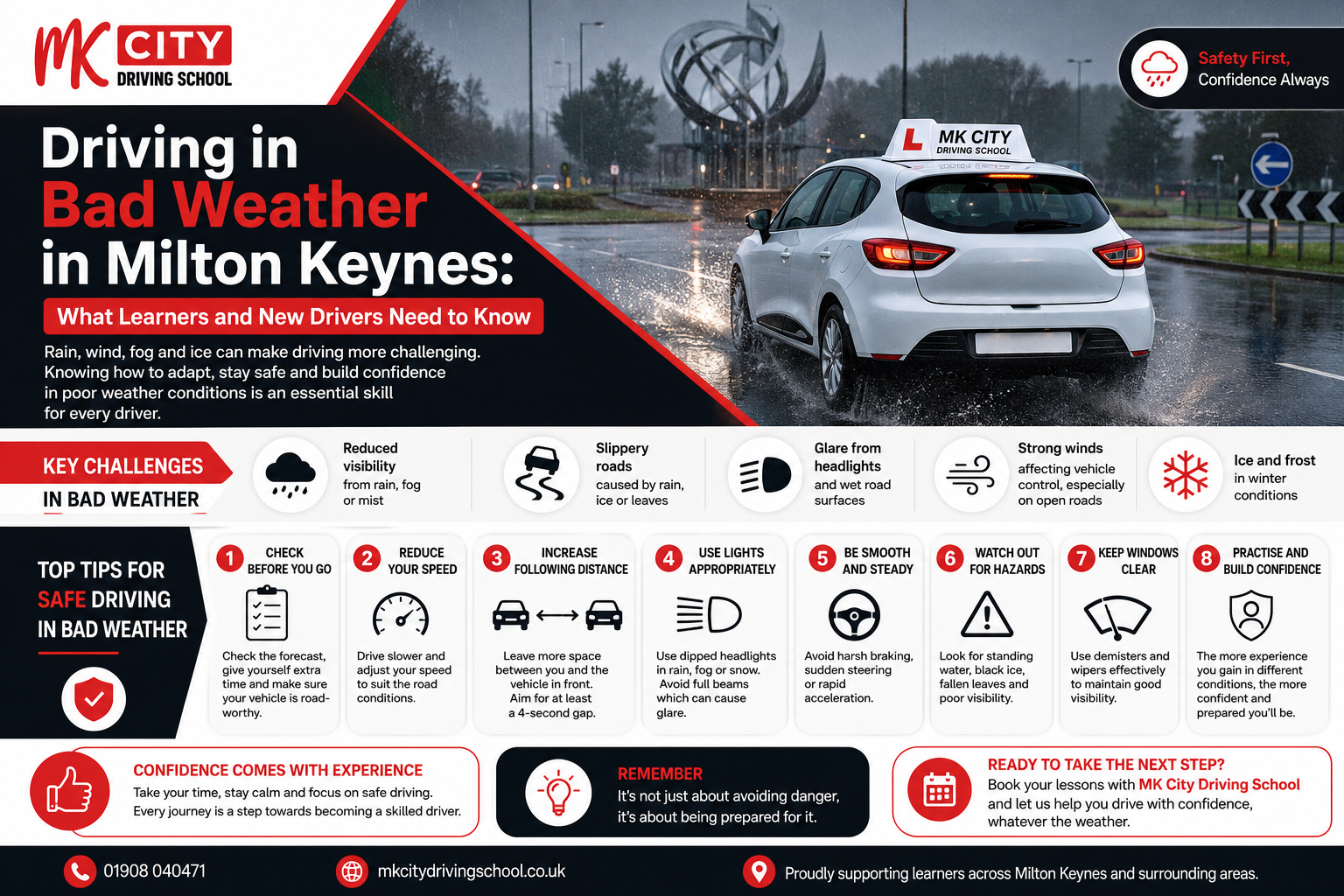
Most learner drivers in Milton Keynes complete the majority of their training in dry conditions during daylight hours. This is natural, because lessons tend to be booked during daytime slots and the British summer is reasonably kind to the scheduling of most practical tests. But the roads do not stay dry, and the conditions that present the greatest risk to learners and newly qualified drivers are precisely those that were most absent from their training.
Rain, fog, strong wind, ice, and standing water all change the demands of driving in ways that require specific adjustments. On Milton Keynes roads, where the grid road network carries traffic at higher speeds than most UK towns and the roundabout density means frequent complex decisions, these adjustments matter more than they do in simpler road environments.
This guide covers every major bad weather condition a driver in Milton Keynes is likely to encounter, explains what specifically changes about driving in each condition, and sets out what learners and newly qualified drivers can do to build genuine competence and confidence in difficult weather, including through our Pass Plus programme.
If you are a newly qualified driver who found the test was more stressful than expected, our guide on what to do after failing your driving test in Milton Keynes covers rebuilding confidence step by step.
Why Bad Weather Driving Matters More in Milton Keynes
Before looking at each weather condition individually, it is worth understanding why Milton Keynes roads specifically amplify the demands of bad weather driving compared to most other UK towns.
The grid road network carries traffic at 40 to 70 miles per hour across much of the town. In wet or icy conditions, the stopping distances at these speeds increase significantly, and the consequences of a misjudgement at high speed are more serious than the same misjudgement at 20 miles per hour on a residential road. The wide lanes of the grid roads, which cause some learners to drift toward the centre line even in dry conditions, become more problematic in wet weather when road surface adhesion is reduced and steering corrections feel less precise.
The roundabout density creates a specific challenge in poor weather. Multi-lane roundabouts such as the Grafton Gate interchange require precise lane selection, good observation of road surface markings, and confident speed management. When the road surface is wet, visibility is reduced, and other drivers are behaving with less predictability, each of these demands is amplified. Road surface direction arrows, which are critical for lane selection at complex MK roundabouts, become harder to read when wet and under artificial light.
Understanding these specific local factors means that bad weather preparation for Milton Keynes drivers needs to be more thorough than generic advice would suggest.
Rain and Wet Roads
Rain is the most frequent bad weather condition in the UK and the one that most learners are most likely to encounter during their lessons and test. Despite this frequency, many learners are not specifically prepared for the adjustments that wet road conditions require.
The most fundamental change in wet conditions is stopping distance. The Highway Code quotes a stopping distance of 73 metres at 60 miles per hour in dry conditions. In wet conditions, this typically doubles to around 146 metres. On the grid roads of Milton Keynes, where traffic flows at or near 60 miles per hour on many sections, this doubling of stopping distance has direct practical implications for how much space you should maintain between your vehicle and the one ahead.
Traction is reduced on wet roads, which affects both acceleration and braking. Accelerating too sharply from a standstill, particularly in a manual driving lesson vehicle where clutch control affects how smoothly power is delivered, can cause wheelspin on slippery surfaces. Braking more firmly than the wet road surface can handle causes the wheels to lock up, which in vehicles without ABS results in a skid and loss of directional control. Both are avoided by smooth, gradual inputs rather than sudden ones.
Aquaplaning is a risk specific to wet conditions that few learners have experienced before their first independent wet weather drive. When water builds up on the road surface faster than a tyre can disperse it, the tyre effectively lifts off the road surface and rides on a thin layer of water. Steering and braking both lose effectiveness. The correct response is to ease off the accelerator gently without braking sharply, and allow the vehicle to slow until the tyres regain contact with the road surface.
Visibility in rain is significantly reduced, and this affects not only how far ahead you can see but how early other road users can see you. Using your headlights in heavy rain, even during daylight, is good practice that makes your vehicle visible to others well before they can identify it from its shape alone.
At MK City Driving School, our local driving instructors in Milton Keynes incorporate wet weather driving into lessons throughout the year, ensuring learners develop these adjustments through experience rather than discovering them for the first time alone.
Fog
Fog is the weather condition that most clearly exposes the risk of driving faster than your stopping distance allows. In dense fog, your seeing distance may be reduced to 30 or 40 metres. At 60 miles per hour on a grid road, your stopping distance is 73 metres. This means in dense fog you are driving faster than you can stop within the distance you can see.
The legal requirement for using rear fog lights is that visibility is reduced to 100 metres or less. This is a figure worth internalising, because many drivers use rear fog lights too infrequently in early fog and then forget to turn them off when visibility improves, causing unnecessary glare for drivers behind.
Front fog lights, if your vehicle has them, should be used to supplement your dipped headlights in conditions where they genuinely improve your forward visibility. They should not be used routinely in drizzle or light rain as a substitute for main headlights.
Following distance in fog should be significantly extended. Use the two-second rule in normal conditions as a minimum and extend this considerably in fog, because the vehicle ahead may brake more sharply than expected and your reaction to a brake light you cannot see until it is close is necessarily slower.
On the grid roads of Milton Keynes, fog creates specific junction hazards. Traffic emerging from side roads may not see approaching grid road traffic until they are already committed to the junction. Approach junctions on the grid roads with additional caution in fog, even when you have right of way.
Ice and Frost
Ice is the most dangerous common weather condition for drivers in the UK, and the period when it is most hazardous is the one least expected by learners who trained primarily in dry conditions.
Black ice, which is a thin transparent layer of ice that forms on the road surface without the visual cues of frost or snow, is particularly dangerous because it is effectively invisible. Road surfaces most likely to carry black ice are bridges, exposed sections of the grid road network with no sheltering buildings or trees, and shaded sections that do not receive direct sunlight during the day.
Stopping distances on ice can be up to ten times the dry distance. At 30 miles per hour on ice, your stopping distance may be as long as your full dry distance at 70 miles per hour. This requires approaching every junction, roundabout, and pedestrian crossing with a dramatically extended following distance and much earlier braking than would be needed in any other condition.
Steering inputs and braking should be smoother and more gradual on ice than in any other condition. Abrupt steering or sudden braking will cause the vehicle to skid, and recovery from a skid on ice is significantly more difficult than on a dry or wet surface.
The most effective strategy for dealing with ice is awareness of when it is likely to be present, which is any time the temperature is at or below 4 degrees Celsius, and building in significantly more travel time to allow the reduced speeds that ice conditions require.
Wind
Strong wind is less frequently discussed as a bad weather condition for drivers but is genuinely significant, particularly for learners and newly qualified drivers on Milton Keynes roads.
The grid roads are predominantly straight and exposed, with open sections that funnel wind across the carriageway. High-sided vehicles such as lorries and vans create significant buffeting as they pass or are passed, and this buffeting is amplified by cross-winds that push the air mass from the side of a passing vehicle rather than its slipstream.
For learners on dual carriageways, the first experience of significant buffeting from a passing lorry can be startling and may cause an instinctive steering reaction away from the source of the buffeting. The correct response is to hold your steering line firmly and allow the buffeting to pass rather than steering away from it, which risks moving toward the vehicle or into another lane.
All-Weather Preparation Through Pass Plus
The Pass Plus programme available through MK City Driving School includes a dedicated all-weather driving module covering rain, fog, ice, and strong wind conditions. The module provides structured guided experience in real weather conditions with a DVSA-approved instructor in a dual-control vehicle, which converts bad weather from a source of uncertainty into a set of specific, manageable adjustments.
For newly qualified drivers in Milton Keynes who want to build genuine all-weather confidence before encountering these conditions alone for the first time, Pass Plus is the most structured and effective route available. Combined with the motorway and night driving modules, it addresses the three most significant experience gaps that the standard practical test leaves open.
Learn more about automatic driving lessons and how they handle wet weather in Milton Keynes if you are considering the best vehicle type for all-weather training.
For drivers who want to read more about how to stay confident in all conditions, our guide on driving test confidence in Milton Keynes covers the mental preparation side alongside the technical skills.
Frequently Asked Questions
Q: How should I adjust my driving in heavy rain in Milton Keynes?
Increase your following distance to at least double the normal two-second rule. Reduce your speed on the grid roads to account for the significantly increased stopping distances on wet road surfaces. Use your headlights even in daylight to ensure you are visible to other road users. Apply all steering and braking inputs more gradually than you would in dry conditions to avoid loss of traction.
Q: When should I use rear fog lights in Milton Keynes?
The legal requirement is when visibility is reduced to 100 metres or less. Turn them off when visibility improves beyond this threshold, as they cause unnecessary glare for drivers behind you. Do not use rear fog lights routinely in rain or drizzle.
Q: What is aquaplaning and what should I do if it happens?
Aquaplaning occurs when water on the road surface cannot be dispersed by your tyres quickly enough, causing the tyre to ride on a thin film of water and lose contact with the road. Steering and braking both become ineffective. Ease gently off the accelerator without braking sharply, and allow the vehicle to slow until tyres regain road contact.
Q: Are driving lessons in Milton Keynes available in bad weather?
Yes. MK City Driving School provides driving lessons in Milton Keynes throughout the year in all weather conditions. Driving in rain, reduced visibility, and varying road surface conditions is an important part of developing real-world competence and is incorporated into lessons naturally rather than avoided.
Q: Does Pass Plus cover bad weather driving?
Yes. The Pass Plus programme at MK City Driving School includes a dedicated all-weather driving module covering rain, fog, ice, and wind. The module is conducted with a DVSA-approved instructor in a dual-control vehicle in real weather conditions.
Q: What is the most dangerous weather condition for new drivers in Milton Keynes?
Ice presents the greatest objective danger because stopping distances increase up to tenfold and the warning signs of black ice are often invisible until it is experienced directly. However, fog is also highly dangerous because it exposes the risk of driving faster than your stopping distance allows, which many newly qualified drivers do not adequately adjust for without prior experience of genuine fog conditions.
Final Thoughts
Bad weather driving on Milton Keynes roads is genuinely more demanding than bad weather driving in most other UK towns, because the grid road speeds and roundabout density amplify every adjustment that adverse conditions require. Understanding what those adjustments are, practising them under professional guidance, and approaching poor conditions with the deliberate caution they deserve are the three things that separate drivers who manage bad weather confidently from those who find it genuinely frightening.
At MK City Driving School, our driving instructors in Milton Keynes incorporate bad weather preparation into lessons throughout the year and offer the Pass Plus all-weather module for newly qualified drivers who want structured guidance beyond the standard test preparation. We serve learners across the full MK postcode area from MK1 to MK19.
Meet our instructors | View all courses | MK City Driving School home
MK City Driving School | Milton Keynes, Buckinghamshire | MK1 to MK19 Tel: 07730 038695 | mkcitydrivingschool.co.uk | 7am to 8pm, 7 days a week Serving: Milton Keynes, Bletchley, Newport Pagnell, Woburn Sands, Stony Stratford, Olney, Hanslope and surrounding areas