


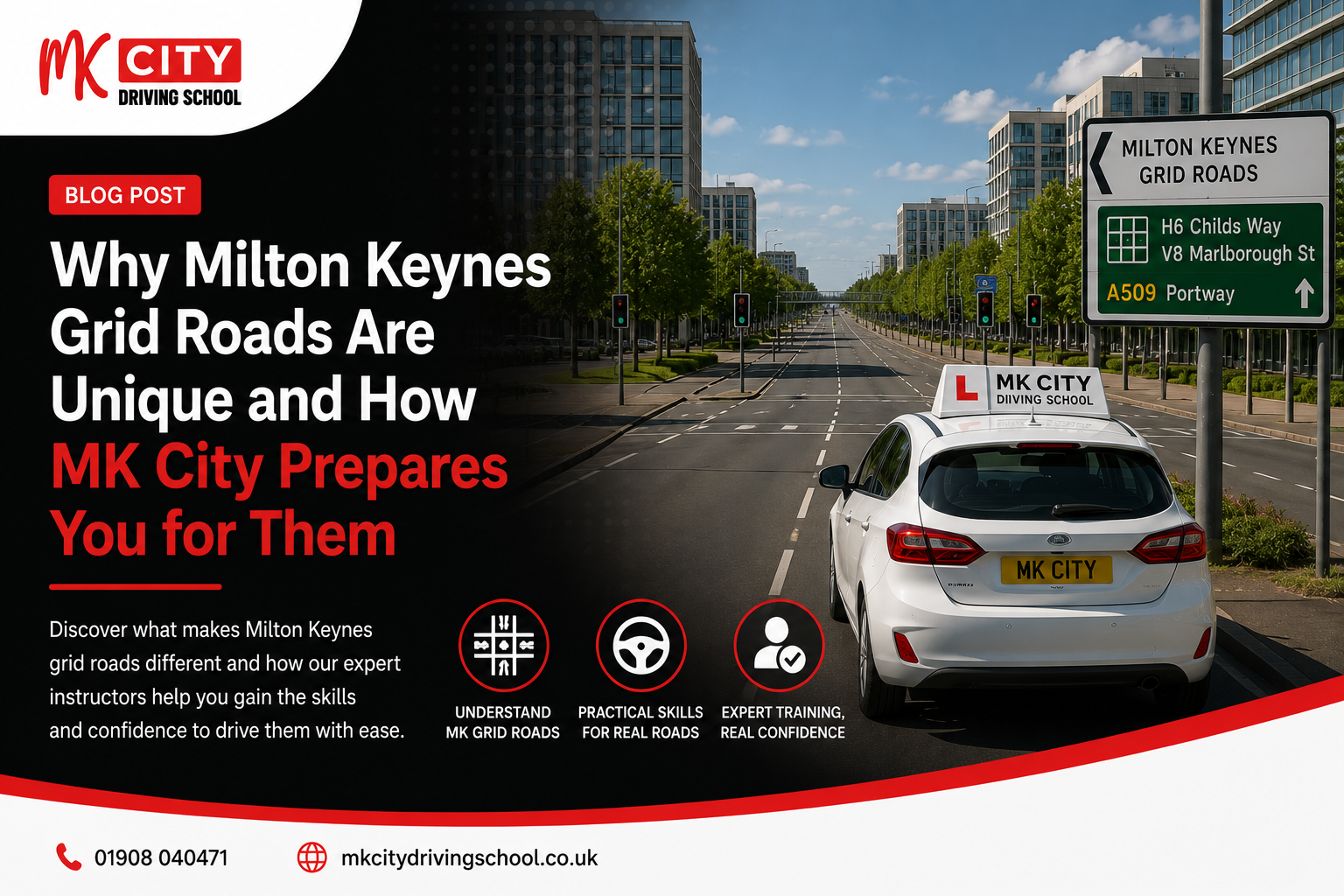
Milton Keynes was designed from scratch in the 1960s and opened progressively from the early 1970s. Its road network was not built around an existing town centre, a market square, or a medieval street plan. It was planned from a blank sheet of paper with the car as the primary form of transport and efficiency of movement as the primary design principle.
The result is the grid road system: a network of horizontal H roads and vertical V roads that intersect at roundabouts across the town, forming a regular grid that allows traffic to flow across Milton Keynes without the stop-start of traditional urban traffic management. This system is genuinely unlike any other road environment in the UK, and learners who train here develop a breadth and depth of driving experience that is significantly different from those who learn in a conventional UK town.
At MK City Driving School, our driving instructors in Milton Keynes have been teaching learners on the grid road network for over fifteen years. This guide explains what the grid roads are, why they are genuinely different from other road environments, what specific skills they require, and how every MK City lesson programme prepares learners specifically for these conditions rather than relying on generic driving instruction.
If you are preparing for your test and want to understand how grid road confidence affects your result, our guide on driving test confidence in Milton Keynes covers the specific preparation that makes the biggest difference at the Bletchley test centre.
The Grid Road System: What It Is and How It Works
The Milton Keynes grid road system is based on a network of roads designated by their position in the grid. Horizontal roads running roughly east to west are designated H roads, numbered from H1 in the north to H10 in the south. Vertical roads running roughly north to south are designated V roads, numbered from V1 in the west to V11 in the east.
The most significant of these for learners and everyday drivers are the central grid roads. The H6 Childs Way runs east to west across the middle of the town and is one of the busiest and most frequently used sections of the network. The V6 Grafton Street runs north to south through the central shopping and commercial district. These two roads, and the roundabout where they meet at the Grafton Gate interchange, form one of the most complex and most frequently encountered junction systems for learners training in MK.
Each grid road is a dual carriageway with a central reservation dividing the two directions of traffic. Most grid roads have two running lanes in each direction, with the speed limit ranging from 40 miles per hour in the more densely built-up sections to 50 miles per hour on the open grid stretches and national speed limit on some rural grid extensions.
The roads are connected at roundabouts rather than traffic lights in most locations, which is why roundabout competence is so central to driving in Milton Keynes.
Why the Grid Roads Are Harder Than They Look
From the outside, the grid road system looks simple. Straight roads, consistent speeds, clear markings, regular roundabouts. In practice, learners encountering the grid roads for the first time frequently find them more demanding than they expected for several specific reasons.
The speed environment changes everything. Learners who have spent their early lessons on 20 to 30 miles per hour residential roads encounter the grid roads as a significant shift in the speed of everything happening around them. Traffic closing from the rear at 50 miles per hour, vehicles merging from slip roads at junction points, and the reduced time available for each decision all feel categorically different from the residential driving that dominates the early stages of most lesson programmes.
Lane discipline on a wide road is a different skill from lane keeping on a narrow one. The wide lanes of the H and V roads cause some learners to drift toward the lane centre or away from it, because the visual references that anchor position on a narrower road are less present. Maintaining consistent position in a lane without drifting requires specific practice on these roads rather than transferring the technique from narrower residential streets.
The roundabouts are not all the same. Some Milton Keynes roundabouts are simple single-lane junctions. Others, like the Grafton Gate interchange, are complex multi-lane systems where the direction you take requires correct lane selection on the approach, and where the consequences of being in the wrong lane are more significant than at a simple two-lane roundabout. Learners who understand the general principle of roundabout driving but have not specifically practised the complex multi-lane versions find these junctions disproportionately demanding under test pressure.
Junction distances are long, but decision windows are short. On grid roads, the distance between junctions can be several hundred metres or more, which means the information needed for the next decision, which exit, which lane, is available for reading well in advance. Learners who are accustomed to reacting to junctions as they appear, rather than reading the road and preparing well ahead, find that the speed of the grid road environment compresses the time they feel they have to make each decision.
The Grafton Gate Interchange: The Most Demanding Junction in MK
The Grafton Gate interchange is the junction where the H6 Childs Way, the V6 Grafton Street, and the approach to the central Milton Keynes shopping and commercial district converge. It is a complex multi-lane roundabout that features on most test routes from the Bletchley test centre and is the junction that generates the highest volume of positioning errors among learners who have not been specifically prepared for it.
The approach to Grafton Gate from multiple directions requires correct reading of road surface direction arrows, early lane selection based on the intended exit, and confident speed management on the roundabout itself while maintaining awareness of vehicles in adjacent lanes.
The most common error at this junction is entering the roundabout in the wrong lane because the direction arrows were read too late for a safe positional adjustment. The second most common is inappropriate speed on the roundabout itself, either too fast for the lane position and traffic around the learner, or too slow in a way that creates hazards for following vehicles.
At MK City Driving School, every learner who is approaching test standard has specifically practised Grafton Gate and the other complex roundabouts on the Bletchley test centre routes, in multiple sessions and at varying traffic levels, until the junction feels familiar and the approach routine is automatic.
How MK City Driving School Specifically Prepares Learners for Grid Roads
Generic driving instruction teaches learners to drive. Locally rooted driving instruction in Milton Keynes teaches learners to drive on these specific roads, at these specific speeds, through these specific junctions.
At MK City Driving School, the introduction of grid road driving follows a deliberate progression. In the early lessons, the focus is residential roads and simple junctions where the fundamental controls, observation routines, and basic junction procedures are established. As these foundations become reliable, the lesson programme progressively introduces the grid road environment.
The first grid road sessions are typically on quieter grid road sections at lower traffic times, allowing learners to experience the speed environment and the wider lanes without the full complexity of the peak-hour grid road dynamic. From there, the progression moves toward the junctions used on the test routes, practising the specific approaches, the direction arrow reading, and the multi-lane roundabout techniques that the Bletchley test will assess.
By the point a learner is approaching their practical test date, the grid roads and their key junctions have been driven many times. The H6 Childs Way, the V6 Grafton Street, and the Grafton Gate interchange are familiar rather than intimidating, because familiarity is specifically what this preparation is designed to create.
For learners considering automatic driving lessons in Milton Keynes, it is worth noting that automatic transmission genuinely reduces the cognitive load of grid road driving in early stages. Without gear management, learners can focus entirely on the speed management, lane discipline, and roundabout reading that the grid roads require rather than splitting their attention between car control and road awareness.
Grid Roads in the Driving Test: What the Examiner Is Looking For
The Bletchley test centre routes almost always include sections of the grid road network. What the examiner is specifically assessing on these sections includes speed management appropriate to the grid road environment, consistent lane positioning without drifting across the width of the wide lanes, correct reading and early response to direction arrows at roundabout approaches, smooth and confident roundabout entry and exit at appropriate speed, and correct mirror use before any speed change or lane change on the dual carriageway sections.
Each of these is a skill built through specific practice on the grid roads themselves rather than a transferable skill from other road types. A learner who has driven the H6 Childs Way and V6 Grafton Street many times in lessons is demonstrably better prepared for these assessment criteria than one who has not, regardless of how competent they are on other road types.
This is why local knowledge in a driving school is not a marketing phrase. It is a genuine practical differentiator between the preparation you receive from a locally rooted school and the preparation you receive from a school with instructors rotating through the area without specific grid road expertise.
If you have already sat a test at the Bletchley test centre and experienced difficulty on the grid road sections, our guide on what to do after failing your driving test in Milton Keynes explains how to use your fault report to target exactly what needs to change.
Frequently Asked Questions
Q: What makes Milton Keynes grid roads different from other UK roads?
The grid road system is a planned network of dual carriageway H and V roads intersecting at roundabouts, designed to allow cross-town traffic flow without traditional urban stop-start management. The combination of dual carriageway speeds, wide lanes, multi-lane roundabouts, and road surface direction arrows as the primary navigational guidance creates a driving environment genuinely unlike most other UK towns.
Q: What speed limits apply on Milton Keynes grid roads?
Most grid roads in built-up central MK carry a 40 mile per hour speed limit. Some sections carry a 50 mile per hour limit. Rural grid road extensions can carry a national speed limit of 60 miles per hour. Speed limit signs and repeater signs on the central reservation confirm the applicable limit at any point.
Q: Which roundabout is the most challenging for learners in Milton Keynes?
The Grafton Gate interchange, where the H6 Childs Way and V6 Grafton Street meet in central Milton Keynes, is consistently the most demanding junction for learners due to its multi-lane approach, the volume of direction information that must be read and acted on quickly, and its frequent appearance on Bletchley test centre routes. MK City Driving School specifically practises this junction with every learner approaching test standard.
Q: Does learning to drive on grid roads make you a better driver overall?
Yes, in the sense that grid road training develops specific skills, including speed environment management, dual carriageway lane discipline, and complex multi-lane roundabout reading, that drivers who train exclusively in simpler road environments do not develop in the same way. These are genuinely valuable transferable skills for any driving on A-roads and dual carriageways across the UK.
Q: Is it harder to learn to drive in Milton Keynes than in other UK towns?
The grid roads add genuine complexity that is specific to this area, and learners encounter more demanding road environments earlier in their training than those in most other UK towns. However, with the right instruction from a locally experienced school like MK City Driving School, this complexity is introduced progressively in a way that builds competence rather than overwhelm.
Q: How does MK City Driving School introduce the grid roads during lessons?
The grid roads are introduced progressively from early intermediate stage onward, starting with quieter sections at lower traffic times and building toward the complex junctions and peak-hour conditions of the full grid road network. Every learner practises the specific junctions used on the Bletchley test centre routes repeatedly before their practical test date.
Final Thoughts
The Milton Keynes grid road system is one of the most distinctive driving environments in the UK, and learning to drive confidently on it is one of the most genuinely transferable skills a new driver can develop. The dual carriageway discipline, the roundabout reading, the direction arrow awareness, and the speed environment management that MK roads demand are skills that make every driver who trains here more competent on any comparable road in the country.
At MK City Driving School, our local driving instructors in Milton Keynes know these roads in the specific, detailed way that only comes from teaching on them every day for over fifteen years. Every learner who trains with us is specifically prepared for the grid roads, the Grafton Gate interchange, and the full range of MK road conditions, across the full postcode area from MK1 to MK19.
Meet our instructors | View all courses | MK City Driving School home
MK City Driving School | Milton Keynes, Buckinghamshire | MK1 to MK19 Tel: 07730 038695 | mkcitydrivingschool.co.uk | 7am to 8pm, 7 days a week Serving: Milton Keynes, Bletchley, Newport Pagnell, Woburn Sands, Stony Stratford, Olney, Hanslope and surrounding areas