


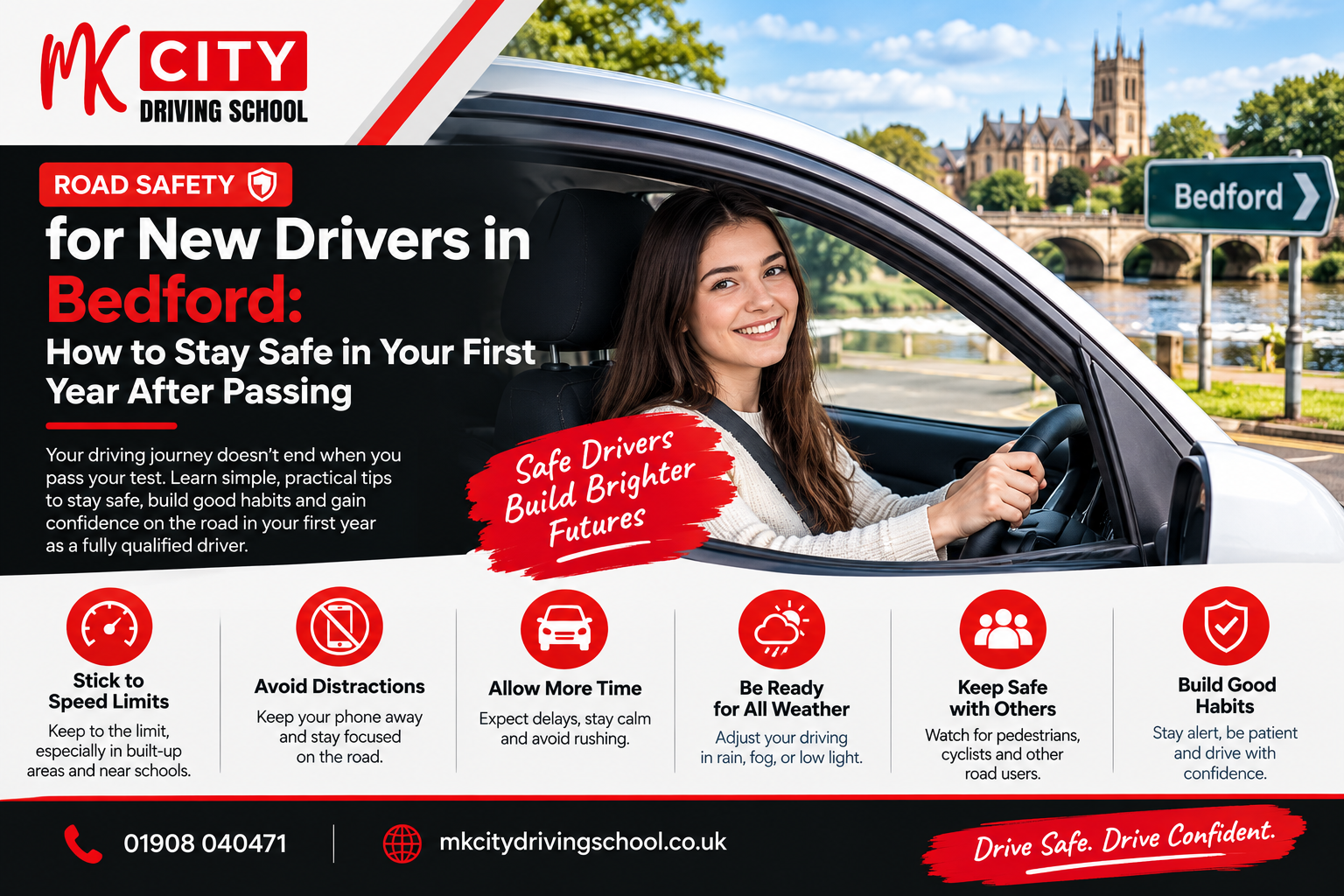
Passing your driving test is the moment most learners have been working toward throughout their entire training programme. It is also, statistically, the beginning of the most dangerous period of their driving lives.
The first year after passing is when newly qualified drivers in the UK are at their highest lifetime accident risk. Insurance actuaries, DVSA road safety data, and the RAC Foundation all identify the twelve months immediately following the practical test as the period where the gap between legal competence, which the test confirms, and genuine real-world driving experience, which takes years to accumulate, is at its widest. Most first-year incidents do not happen because newly qualified drivers are reckless. They happen because the skills, habits, and judgements that make driving genuinely safe in complex real-world conditions take more than a test to develop.
For newly qualified drivers in Bedford, this picture has specific local dimensions. The A6 and A421 dual carriageway sections, the rural Bedfordshire roads toward Ampthill and the surrounding villages, the M1 accessible from Bedford via the A421, and the particular demands of Bedford town centre at peak times all present conditions that learner training addresses partially but that independent driving exposes fully for the first time.
At MK City Driving School, our driving instructors in Bedford see the progression of newly qualified drivers regularly and this guide reflects the specific road safety knowledge that makes the biggest difference in the first year.
Why the First Year Is the Highest-Risk Period
Understanding why the first year carries elevated risk helps newly qualified Bedford drivers approach it with the right awareness rather than the assumption that a passed test means a fully developed driver.
The practical driving test assesses whether a learner meets a minimum competency threshold across a defined set of road conditions. It does not and cannot assess how that learner performs in conditions the test does not include: motorways, night driving, genuinely adverse weather, complex multi-vehicle scenarios, high-speed rural roads. These conditions require a learner to apply the skills built during training to situations that are new and that do not come with an instructor in the passenger seat to observe, advise, or intervene.
The cognitive load of driving is also significantly higher in the first year than it becomes after several years of regular independent driving. Experienced drivers perform many elements of the driving task automatically, freeing attention for the novel or complex situations that actually require conscious thought. Newly qualified drivers are still in the process of building that automaticity. More of the driving task requires conscious attention, which leaves less cognitive capacity available for dealing with unexpected events.
This is not a reason for alarm. It is a reason for specific awareness, deliberate habit maintenance, and in many cases structured post-test development such as Pass Plus, which gives newly qualified Bedford drivers professional guidance in exactly the conditions the standard test leaves unaddressed.
Risk Factor 1: Night Driving in Bedford
Night driving is the single condition most consistently identified by road safety researchers and the insurance industry as a contributor to newly qualified driver incidents in the first year. Most learners complete their entire practical training in daylight. The standard test is conducted in daylight. The first time most newly qualified Bedford drivers encounter genuine after-dark driving is alone, after passing.
The specific challenges of night driving that differ from the daytime experience include reduced visibility beyond the range of headlights, the management of headlight dazzle from oncoming vehicles, the reduced visual information available for reading hazards at distance, and the different behaviour of other road users including pedestrians and cyclists who are less visible and sometimes less predictable at night.
For Bedford drivers, the transition from the reasonably lit town centre and surrounding residential areas to the significantly darker rural roads toward Kempston, Wootton, Elstow, and the Bedfordshire villages happens quickly and the change in road character after dark is more significant than many newly qualified drivers expect the first time they experience it.
The most effective preparation for night driving in Bedford is the Pass Plus night driving module, which provides structured professional guidance in exactly these conditions before the first solo after-dark journey. For guidance on building genuine confidence as an independent driver across all conditions, our driving test confidence guide covers the mindset elements that apply equally to test preparation and early independent driving.
Risk Factor 2: Motorway Driving
Motorway driving is not part of the standard UK practical test. For newly qualified Bedford drivers, the M1 is accessible from the A421 west of the town and is used by a significant proportion of Bedford drivers for work and regular travel, often within the first weeks of passing.
The specific demands of motorway driving that differ from anything in the standard test include joining from a slip road at speed, sustained driving at 70 miles per hour with appropriate lane discipline, safe following distances at motorway speed that are significantly greater than those needed on A-road dual carriageways, the management of smart motorway gantry signals and variable speed limits, and the procedure for breaking down on a live motorway including the use of emergency refuge areas.
A newly qualified Bedford driver who joins the M1 at Junction 13 without any prior professional motorway experience is managing all of these demands simultaneously for the first time alone. Most manage without incident. The ones who do not are disproportionately represented in first-year newly qualified driver incident statistics.
The Pass Plus motorway module provides structured professional support before the first solo motorway journey, using the actual M1 sections relevant to Bedford drivers. This is the most direct available preparation and the one with the most immediately measurable impact on motorway safety for newly qualified Bedford drivers.
Risk Factor 3: Carrying Passengers
One of the most consistent and most underappreciated first-year risk factors for newly qualified drivers is the presence of passengers, particularly peer-age passengers. Research from the RAC Foundation and road safety organisations consistently shows that newly qualified drivers carrying passengers in the same age group face a meaningfully elevated accident risk compared to solo driving.
The mechanism is well understood. Social dynamics in the vehicle create pressure, distraction, and in some cases direct encouragement toward behaviours such as higher speed or accepting reduced headway that the driver would not adopt alone. The cognitive load of managing a social environment in the vehicle simultaneously with the driving task reduces the attention available for the road at exactly the stage when cognitive capacity for driving is most limited.
For newly qualified Bedford drivers, the practical guidance is to build solo driving confidence before routinely carrying passengers, to be honest about the additional risk that peer passengers represent in the early months, and to be willing to decline situations that feel outside their current comfort level regardless of social pressure.
Risk Factor 4: Speed Management on Bedford’s A-Roads
The A6 and A421 represent the highest-speed road environment most Bedford learners experience during their standard training. After passing, newly qualified Bedford drivers encounter these roads without an instructor, and in conditions that may differ significantly from those present during lessons.
The specific risk in the first year on A-road dual carriageway sections around Bedford is not usually deliberate speeding. It is the gradual drift upward from appropriate speed that happens when the moderating influence of an instructor is no longer present and when attention is partly consumed by other aspects of the driving situation. A newly qualified Bedford driver who is simultaneously managing navigation, a conversation with a passenger, an unfamiliar section of the A421, and the expectation of a junction may find that their speed has crept above the limit before they register it.
Frequent speedometer checks, a deliberate habit of speed awareness rather than reliance on feel, and maintaining appropriate following distances at higher speeds are the specific behaviours that address this risk on Bedford’s A-road network in the first year.
Risk Factor 5: Rural Bedfordshire Roads
The rural roads surrounding Bedford toward Ampthill, Sandy, Shefford, and the Bedfordshire villages introduce national speed limit single-carriageway driving that differs from both the urban and the dual carriageway environments most Bedford learners are most thoroughly prepared for.
The combination of higher speeds, reduced sightlines around bends and crests, agricultural vehicle hazards, and farm access junctions that appear without warning creates a demand on hazard anticipation and forward planning that exceeds what Bedford town centre driving requires. Many first-year incidents on rural roads happen not because of speeding in excess of the limit but because the driver is travelling at a speed that is legal but not appropriate for the actual sightlines and hazard conditions of the specific section of road.
Adjusting speed to the conditions rather than to the limit on rural Bedfordshire roads, treating crests and bends as potential hazard concealment points rather than clear road, and positioning appropriately for oncoming traffic on narrow lanes are the specific habits that reduce rural road risk for newly qualified Bedford drivers in the first year.
Risk Factor 6: Adverse Weather
Newly qualified Bedford drivers who passed their test in reasonable weather conditions have typically had limited structured exposure to driving in genuinely adverse conditions. Rain, fog, ice, and the specific surface conditions of Bedfordshire roads in winter create driving demands that are different in kind rather than just degree from the conditions standard training addresses.
The most critical behaviours for adverse weather driving in Bedford include significantly extending following distances beyond what feels natural at any given speed, reducing speed proactively rather than reactively as visibility or surface conditions deteriorate, understanding the correct and legal use of fog lights and the conditions that require them, and recognising the early signs of aquaplaning on wet A-road sections.
The Pass Plus all-weather module provides structured professional guidance specifically in these conditions. For newly qualified Bedford drivers who complete the programme, adverse weather driving is an area where they have received professional instruction rather than one where their first experience of genuinely demanding conditions is entirely unsupported.
What Newly Qualified Bedford Drivers Can Do
The practical steps that make the biggest difference in the first year are specific and achievable.
Complete Pass Plus before your first solo motorway journey and ideally within the first two months of passing. The motorway and night driving modules address the two highest-risk first-year gaps most directly. MK City Driving School is a registered Pass Plus provider in Bedford delivering all six modules.
Build solo driving confidence before routinely carrying passengers. Use the first weeks of independent driving to consolidate your skills in the vehicle alone before adding the social and cognitive complexity of regular passengers.
Actively monitor your speed on the A6 and A421 rather than relying on feel. The habit of regular speedometer checks is more reliable than speed sense in the first year when the feel for appropriate speed at higher speeds is still being calibrated.
Treat rural Bedfordshire roads as demanding environments that require adjusted speed and increased forward planning regardless of what the speed limit sign says.
Extend your following distances significantly in rain, fog, or ice. The Highway Code minimum of two seconds becomes four seconds in wet conditions and significantly more in ice or fog.
Frequently Asked Questions
Q: Why is the first year after passing the most dangerous time for new drivers in Bedford?
The first year combines legal driving competence confirmed by the practical test with a genuine gap in real-world experience in conditions the test does not assess, including motorways, night driving, adverse weather, and complex multi-vehicle rural road situations. The cognitive load of driving is also higher in the first year than after several years of regular independent driving, leaving less capacity for unexpected events.
Q: What are the biggest road safety risks for newly qualified drivers in Bedford?
Night driving on unlit rural Bedfordshire roads, motorway driving on the M1 via the A421, carrying peer-age passengers, speed management drift on the A6 and A421, rural road hazard anticipation, and adverse weather driving are the most significant first-year risk factors for Bedford newly qualified drivers.
Q: Does Pass Plus help with road safety for new drivers in Bedford?
Yes. Pass Plus provides structured professional guidance in the six conditions the standard test does not address, all of which correspond directly to first-year risk factors. The motorway and night modules are the most immediately relevant for Bedford newly qualified drivers. MK City Driving School is a registered Pass Plus provider in Bedford.
Q: Is it safe to take passengers in the first year after passing in Bedford?
Passengers add cognitive load and social pressure that elevate first-year accident risk, particularly when passengers are the same age as the newly qualified driver. Building solo driving confidence before routinely carrying passengers, particularly on demanding routes including the A6, A421, and rural Bedfordshire roads, is the safer approach for the early months.
Q: How should a newly qualified Bedford driver approach rural roads safely?
Treat speed limits as a ceiling rather than a target on rural Bedfordshire roads. Adjust speed to the actual sightlines and hazard conditions of each section rather than to the posted limit. Treat crests and bends as potential hazard concealment points and be prepared for agricultural vehicles, cyclists, and farm access junctions appearing without warning.
Q: What is the best post-test course for new drivers in Bedford?
Pass Plus is the DVSA-developed post-test programme that directly addresses the most significant first-year risk factors. For Bedford drivers, the motorway module using the M1 via the A421, the night driving module for rural Bedfordshire roads after dark, and the all-weather module are the three most immediately practical. MK City Driving School delivers all six Pass Plus modules across Bedford and Bedfordshire.
Final Thoughts
The first year after passing your driving test in Bedford is the period where specific awareness of the gaps between test standard and full real-world competence matters most. Night driving, motorway driving, rural road hazard reading, adverse weather management, and the social dynamics of carrying passengers are all areas where the standard test leaves newly qualified drivers to develop their own experience without structured support.
Pass Plus, deliberate solo confidence building, active speed management habits, and honest self-assessment of what conditions are genuinely within your current comfort level are the practical tools that make the biggest difference in that first year.
At MK City Driving School, our local driving instructors in Bedford support newly qualified drivers as well as learners, and we would be glad to discuss any aspect of post-test development with you.
Book your Pass Plus or post-test support with MK City Driving School in Bedford, call 07730 038695 or visit mkcitydrivingschool.co.uk
Meet our instructors | View all courses | MK City Driving School home
MK City Driving School | Bedford, Bedfordshire Tel: 07730 038695 | mkcitydrivingschool.co.uk | 7am to 8pm, 7 days a week Serving: Bedford, Kempston, Putnoe, Brickhill, Queens Park, Elstow, Wootton, Great Barford and surrounding Bedfordshire areas