


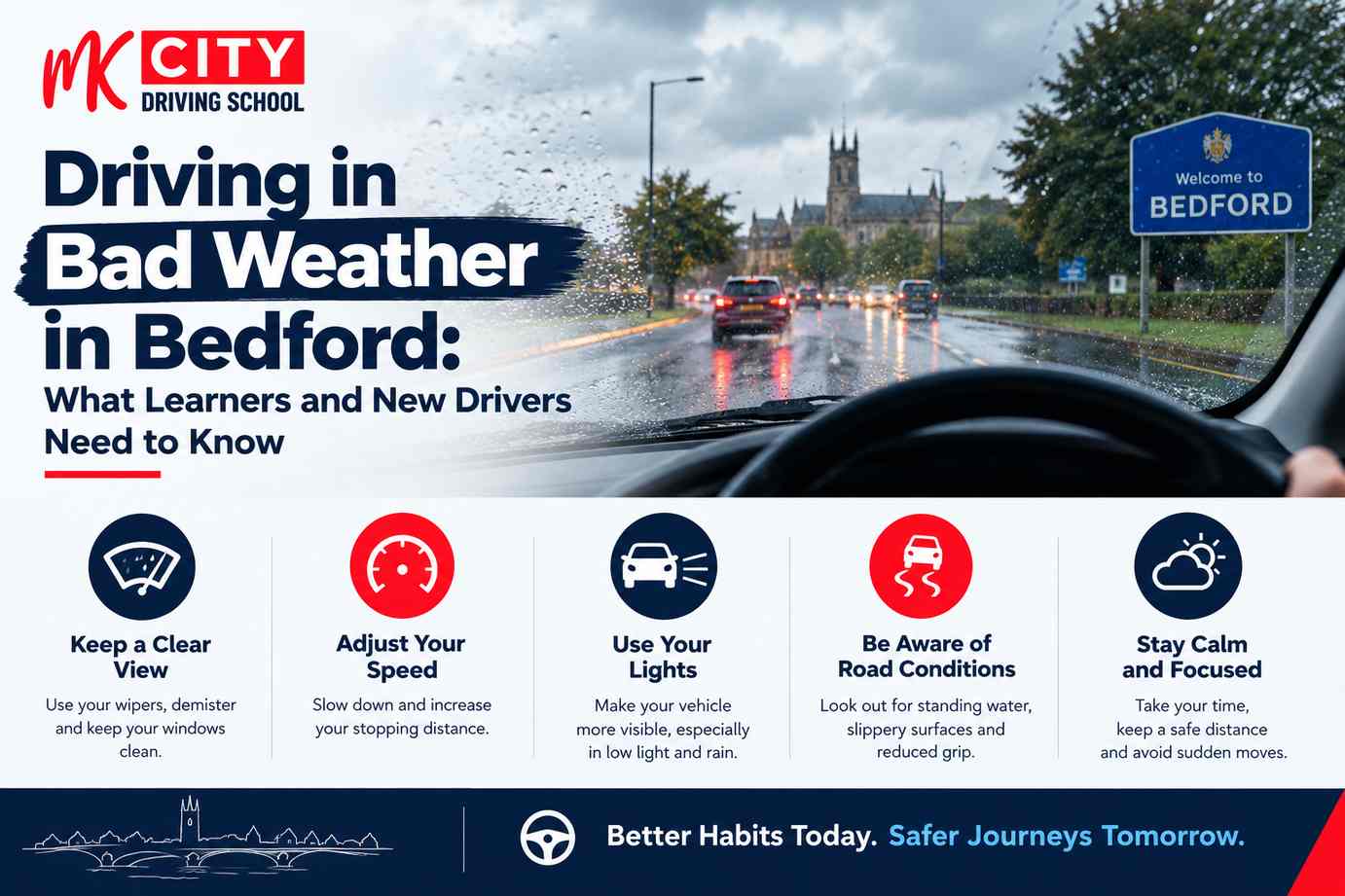
Driving in bad weather is one of the most significant gaps between passing a practical driving test and becoming a genuinely safe independent driver. The standard UK practical test is conducted in daylight and in broadly reasonable conditions. Rain, fog, ice, and strong wind are conditions that most learners encounter during their training only briefly and without structured guidance on how those conditions specifically change what safe driving requires.
For drivers in Bedford, this gap has specific local dimensions. The A6 and A421 dual carriageway sections carry traffic at speeds where the effects of surface water, reduced visibility, and reduced traction are meaningfully more significant than on residential roads. The rural Bedfordshire roads toward Elstow, Wootton, Great Barford, and the surrounding villages introduce national speed limit driving in conditions where reduced sightlines around bends and crests combine with adverse weather to create genuine hazard. The Bedford town centre environment brings its own pedestrian and cyclist visibility challenges in rain and low light.
At MK City Driving School, our driving instructors in Bedford build weather awareness into every lesson programme across Bedford and surrounding Bedfordshire areas. This guide covers every significant bad weather condition and what specifically changes on Bedford roads when each one applies.
Rain: The Most Common and Most Underestimated Condition
Rain is the bad weather condition most learners and new drivers in Bedford underestimate because its familiarity on UK roads produces a dangerous complacency. Many drivers treat wet road conditions as simply requiring slightly lower speed, rather than as a fundamentally different driving environment with specific techniques and significantly extended stopping distances.
The Highway Code is precise on this: stopping distances in wet conditions are at least double those in dry conditions. At 60 miles per hour on the A421 in dry conditions, the total stopping distance including thinking and braking distance is approximately 73 metres. In wet conditions that figure becomes at least 146 metres. A driver maintaining the standard two-second following distance gap in dry conditions at that speed is maintaining an entirely insufficient gap in rain.
The practical implication for Bedford A-road driving is that following distances at dual carriageway speeds on the A6 and A421 in rain need to be significantly larger than what feels natural to a driver whose calibration was built in predominantly dry conditions. The four-second rule in wet conditions, doubling the standard two-second dry gap, is the minimum appropriate standard at higher speeds on Bedford’s A-road network.
Aquaplaning is a specific rain risk on the faster sections of the A6 and A421 and on the lower-lying approaches to Bedford town centre where surface water accumulates after heavy rain. Aquaplaning occurs when a layer of water builds between the tyre and the road surface, causing the tyre to lose contact and the vehicle to become temporarily unsteerable and unable to brake effectively. The correct response to aquaplaning is to ease gently off the accelerator without braking or steering until contact with the road surface is regained. Braking or turning during aquaplaning significantly worsens the loss of control. Reducing speed before identified surface water sections and maintaining adequate tyre tread depth across all four tyres are the most effective preventive measures.
Headlights must be used in rain when visibility is reduced to 100 metres or less. In practice, switching headlights on in any significant rainfall regardless of precise visibility distance makes your vehicle more visible to other road users on Bedford’s A-road and town centre roads and improves your own perception of the road surface ahead.
Fog: Specific Risks on Bedford’s Rural Roads
Fog creates the most acute danger on the rural Bedfordshire roads surrounding Bedford, where the combination of national speed limit driving, reduced sightlines, and limited street lighting produces conditions that are genuinely more hazardous than fog in the town centre environment. Most newly qualified Bedford drivers encounter rural fog for the first time entirely without prior structured guidance.
The Highway Code rule on rear fog lights is precise: use rear fog lights when visibility falls below 100 metres. On rural Bedfordshire roads toward Elstow, Wootton, and Great Barford in genuine fog, visibility can fall below 100 metres suddenly as the road dips or turns. A rear fog light dramatically increases your visibility to following traffic and is legally required in these conditions.
The critical error most drivers make in fog, on both rural Bedfordshire roads and the A6 and A421, is driving at a speed where they cannot stop within the distance they can see ahead. If your headlights illuminate 40 metres of road ahead in fog and your stopping distance at your current speed is 73 metres, you cannot stop in time for a stationary obstruction that appears at the edge of your visibility. Reducing speed until your stopping distance fits within your visible distance is not excessive caution. It is the correct physical response to the conditions.
Never use full beam headlights in fog. Full beam reflects off the fog particles and reduces your own forward visibility while providing no benefit to other drivers. Dipped headlights with rear fog lights switched on is the correct combination in foggy conditions.
The A6 south of Bedford toward Kempston and the rural sections north toward the Bedfordshire villages can experience localised fog in valleys and low-lying sections while higher sections of the same road are clear. Transitioning from clear into dense fog at speed is one of the highest-risk moments of fog driving and requires anticipatory speed reduction on any road section known to carry fog in appropriate weather conditions.
Ice and Snow: When to Drive and When Not To
Ice and snow on Bedford roads change the driving environment more fundamentally than any other adverse weather condition because they simultaneously affect every element of vehicle control. Acceleration, braking, steering, and cornering all behave differently on ice, and the changes are non-linear: a speed that feels manageable in mild ice conditions can become catastrophically inadequate in more severe icing.
The Highway Code states that stopping distances in icy conditions can be up to ten times those in dry conditions. At 40 miles per hour on the A421 in dry conditions, the stopping distance is approximately 36 metres. In ice that figure can extend to 360 metres. No following distance that feels normal in dry conditions is remotely adequate on ice.
For Bedford learners, the roads with the highest black ice risk are the rural Bedfordshire sections, particularly on shaded stretches, on bridges crossing the River Great Ouse, and on the low-lying rural roads toward Elstow and Wootton in the early morning before air temperatures rise above freezing. Black ice is invisible by definition. The first indication of its presence is often steering that feels unusually light or a vehicle beginning to slide without apparent cause. The correct response is to ease gently off the accelerator with no sudden steering inputs and allow the vehicle to slow naturally until traction returns.
Main A-road routes including the A6 and A421 are gritted before residential and rural roads in severe cold weather in Bedfordshire, which may make them comparatively safer in the early stages of an icy period than the surrounding road network. However, the speed environment of dual carriageway driving means the consequences of ice at A-road speeds are significantly more serious than at residential road speeds.
In genuinely severe ice and snow, not driving is a legitimate and sensible decision for any journey that is not essential. A journey that can wait until conditions improve should wait.
Rain During Your Driving Test at Bedford
For learners in Bedford taking their practical driving test in rain, understanding what changes and what does not is useful for managing test-day anxiety.
The test standard does not change in rain. The examiner assesses your ability to drive safely in the actual conditions on the day of your test. Rain on your test day is not a disadvantage. It is an opportunity to demonstrate that you can adjust your driving appropriately to the conditions, which is exactly what good driving requires.
The specific adjustments the examiner will be looking for in rain include extended following distances behind the vehicle ahead on the A6 and A421 sections of the test route, appropriate headlight use if visibility is reduced, and smooth progressive braking rather than sharp late braking that risks locking wheels on a wet surface.
If you have driven in rain during your professional lessons with MK City Driving School, and rain during a test can be treated as a familiar condition rather than an unusual one. Learners who have encountered rain specifically on the Bedford test routes in their lesson programme are considerably better prepared for a wet test day than those who have trained only in dry conditions.
For everything about approaching test day with genuine confidence in any conditions, our driving test confidence guide covers the preparation and mindset that makes the biggest difference on the day.
Wind: A Specific Risk on Bedford’s A-Road Network
Strong crosswind on the A6 and A421 dual carriageway sections affects vehicles at higher speeds in ways that require specific awareness. High-sided vehicles, including vans, lorries, and larger SUVs, are affected more severely than lower-profile cars but any vehicle can be moved laterally by a strong gust at dual carriageway speed.
The specific locations on Bedford’s road network where crosswind risk is highest are the exposed sections of the A421 west of Bedford toward the junction with the M1, where the surrounding landscape is more open, and the A6 sections north and south of the town where the road runs through less sheltered terrain. Gaps between roadside trees, buildings, or cuttings create channelling effects where wind speed increases suddenly as a vehicle passes through an open section.
Maintaining a slightly wider gap from vehicles ahead and from the lane edge on dual carriageway sections in strong wind gives you more space to correct any wind-induced movement before it creates a hazard. A firm, relaxed grip on the steering wheel rather than a tense grip that fights small corrections is the correct technique in crosswind conditions.
For newly qualified Bedford drivers who want structured post-test guidance in all adverse weather conditions including wind, the Pass Plus all-weather module provides professional instruction in a dual-control vehicle specifically covering these conditions. Our automatic driving lessons guide also covers the handling differences between automatic and manual vehicles in adverse conditions that are relevant to licence choice decisions.
Bad Weather and Your Driving Lessons in Bedford
For learners in Bedford, adverse weather lessons are among the most valuable sessions in any training programme. Encountering rain, reduced visibility, and cold road conditions with an instructor alongside you, able to guide your response and correct your approach in real time, is fundamentally different from encountering these conditions for the first time alone after passing.
At MK City Driving School, lessons that coincide with genuine bad weather conditions are treated as teaching opportunities where possible rather than sessions to be cancelled. The A6 and A421 in rain, the rural Bedfordshire roads in reduced visibility, and Bedford’s town centre in cold conditions are all environments that learners benefit enormously from experiencing with professional support before they encounter them alone.
Frequently Asked Questions
Q: Do I need to use headlights in rain while driving in Bedford?
You must use headlights when visibility is reduced to 100 metres or less, which is the legal requirement stated in the Highway Code. In practice, switching headlights on in any significant rainfall regardless of the precise visibility distance makes your vehicle more visible to other drivers on the A6, A421, and surrounding Bedford roads and is strongly recommended.
Q: What are the stopping distances on ice compared to dry roads in Bedford?
The Highway Code states stopping distances in icy conditions can be up to ten times those in dry conditions. At 40 miles per hour in dry conditions the stopping distance is approximately 36 metres. In ice this can become up to 360 metres. On the A6 and A421, this difference makes appropriate speed reduction and extended following distances in icy conditions critically important.
Q: When should I use rear fog lights driving in Bedford?
Use rear fog lights when visibility falls below 100 metres. On rural Bedfordshire roads toward Elstow, Wootton, and Great Barford in genuine fog this threshold is reached quickly. Switch them off when visibility improves above 100 metres. Leaving rear fog lights on when not needed dazzles following drivers and masks your brake lights.
Q: Is it safe to take a driving test in rain at Bedford Driving Test Centre?
Yes. The test standard does not change in rain and a wet test day is an opportunity to demonstrate appropriate weather adjustment rather than a disadvantage. The examiner assesses your ability to drive safely in the conditions on the day. MK City Driving School builds rain driving on the Bedford test routes into every learner programme.
Q: What should I do if my car starts aquaplaning on the A421 in Bedford?
Ease gently off the accelerator without braking or steering and allow the vehicle to slow naturally until tyre contact with the road surface is regained. Braking or steering input during aquaplaning significantly worsens the loss of control. Reduce speed on identified surface water sections proactively and maintain adequate tread depth on all four tyres.
Q: Does MK City Driving School teach in bad weather conditions in Bedford?
Where conditions are safe to do so, MK City Driving School treats adverse weather as a teaching opportunity rather than a cancellation reason. Bedford learners benefit significantly from experiencing rain, reduced visibility, and cold road conditions on the A6, A421, and rural Bedfordshire roads with a professional instructor before encountering them independently.
Final Thoughts
Bad weather driving in Bedford requires specific knowledge and specific technique that goes beyond general caution. The A6 and A421 dual carriageway sections, the rural Bedfordshire roads toward Elstow and Wootton, and the Bedford town centre environment all present distinct challenges in rain, fog, ice, and wind that a driver trained primarily in good conditions is encountering for the first time without structured support.
At MK City Driving School, our local driving instructors in Bedford build weather awareness into every learner programme across Bedford and surrounding Bedfordshire areas, treating adverse conditions as an essential part of complete preparation rather than a disruption to avoid.
Meet our instructors | View all courses | MK City Driving School home
MK City Driving School | Bedford, Bedfordshire Tel: 07730 038695 | mkcitydrivingschool.co.uk | 7am to 8pm, 7 days a week Serving: Bedford, Kempston, Putnoe, Brickhill, Queens Park, Elstow, Wootton, Great Barford and surrounding Bedfordshire areas