


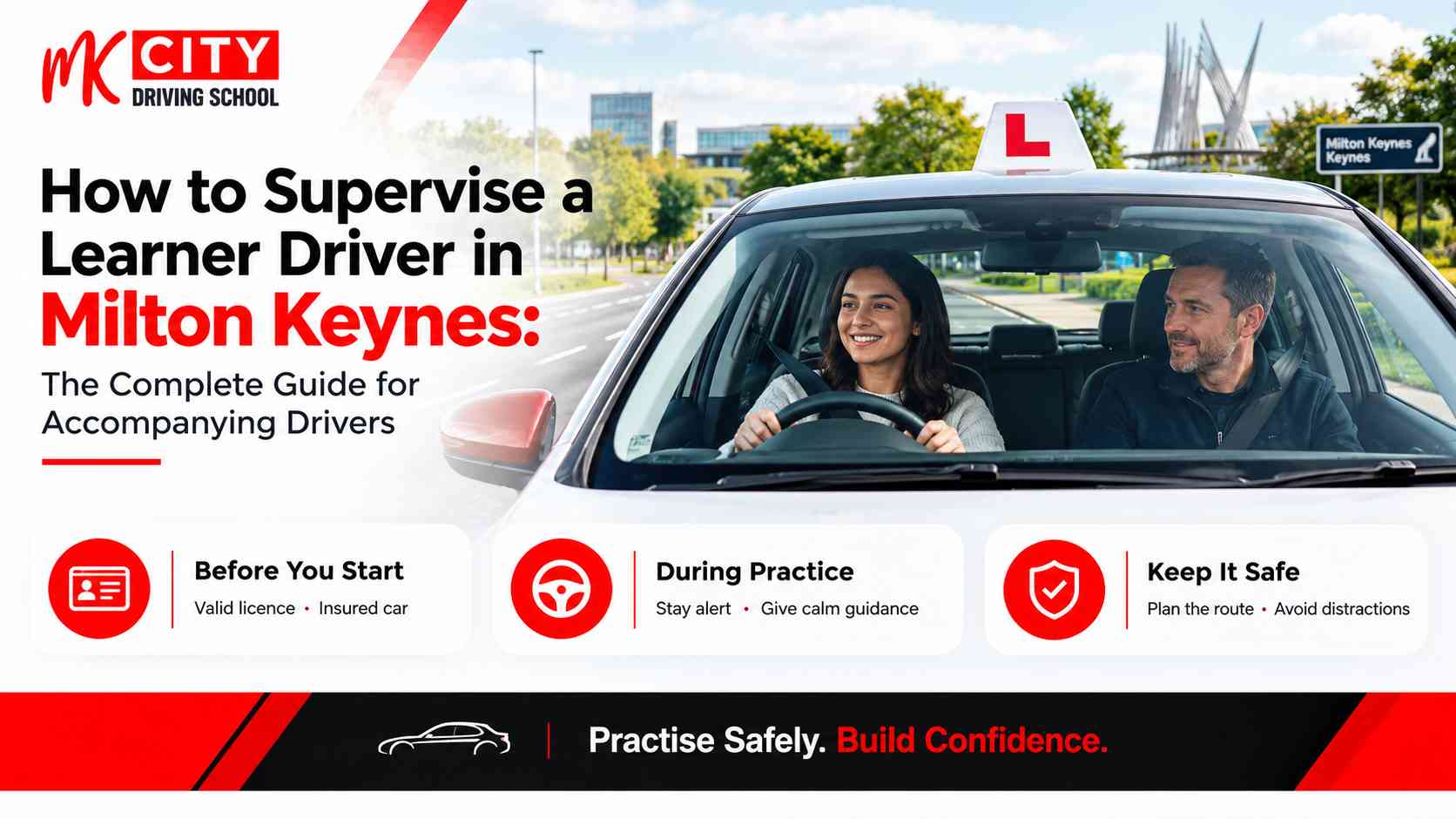
Supervised private practice is one of the most cost-effective tools available to learner drivers in Milton Keynes. The DVSA national average of 45 professional lesson hours reflects how much tuition the typical learner needs without any private practice supplement. Learners who combine regular professional lessons with supervised private practice between sessions consistently reach test standard in fewer total professional lesson hours, because each lesson builds on skills that have been consolidated through additional practice rather than starting from a partial fade of the previous session.
For parents, partners, or other family members in Milton Keynes considering becoming a supervising driver, understanding the legal requirements, the specific demands of the MK road environment, and what makes supervised practice genuinely productive rather than simply additional time behind the wheel is the starting point for doing this well.
At MK City Driving School, our driving instructors in Milton Keynes actively encourage supervised private practice as part of every learner’s programme and advise supervising drivers on what to practise at each stage. This guide covers everything an accompanying driver in Milton Keynes needs to know before getting in the car.
The Legal Requirements for Supervising a Learner Driver
Before any supervised private practice session takes place in Milton Keynes, every legal requirement must be confirmed as met. These are not suggestions. Each one is a legal condition and failing to meet any of them means the learner and the supervising driver are both potentially committing an offence.
You must be at least 21 years old. The minimum age for a supervising driver in the UK is 21. There is no exception to this requirement regardless of how experienced a driver the supervising person is.
You must have held a full UK driving licence for at least three years. The three years must be continuous and the licence must be a full UK licence, not a provisional, not a foreign licence, and not a licence that was revoked and reissued within that period. The three-year requirement runs from the date the full licence was first issued, not from the date of passing the test if the licence was issued later.
The vehicle must be insured to cover a learner driver. This is the requirement most supervising drivers in Milton Keynes fail to check properly and it is the one with the most serious potential consequences. Standard car insurance policies do not automatically cover a learner driver using the vehicle. You must check your insurance policy specifically for learner driver cover, contact your insurer to add it, or take out a separate short-term learner driver insurance policy. Driving an uninsured vehicle is a serious offence carrying a fixed penalty, points on the licence, and the potential for the vehicle to be seized. The fact that it is the supervising driver rather than the insured owner in the vehicle does not provide any protection.
L-plates must be displayed on the front and rear of the vehicle. L-plates must be visible from outside the vehicle at the front and rear. They must be removed or covered when the learner is not driving. Magnetic L-plates that can be removed and reattached easily are the most practical solution for vehicles used for both learner and non-learner driving.
The learner must hold a valid provisional driving licence. The learner must have their provisional licence with them during every private practice session. Supervising a learner who does not hold a provisional licence means the learner is driving illegally regardless of whether the supervising driver meets all other requirements.
Motorways are not permitted. Learner drivers are not legally allowed to drive on motorways during supervised private practice, regardless of how experienced the supervising driver is or how advanced the learner’s skills are. Motorway driving for learners is only permitted with an approved driving instructor in a vehicle with dual controls. For Milton Keynes learners, this means the M1 and the motorway sections of the local network are excluded from private practice routes.
Insurance: Getting This Right Before You Drive
The insurance requirement deserves specific attention because it generates the most confusion among supervising drivers in Milton Keynes and the consequences of getting it wrong are significant.
There are three main routes to insuring a learner driver for supervised private practice on a specific vehicle.
The first is checking whether the existing insurance policy on the vehicle already includes learner driver cover. Some comprehensive policies include this as standard. Read the policy documents carefully or call the insurer directly to confirm. Do not assume comprehensive cover automatically includes learner drivers.
The second is adding a named learner driver to the existing policy as a temporary addition. Many insurers will do this for a modest additional premium during the period of the learner’s training. This is the simplest route if the insurer offers it.
The third is a separate short-term learner driver insurance policy, available from specialist insurers. These policies cover a specific learner driver for a defined period, typically from one week to six months, and are independent of the vehicle owner’s existing policy. They do not affect the vehicle owner’s no-claims bonus in the event of a claim, which makes them a popular choice for parents of young learners in Milton Keynes.
Whichever route you take, confirm in writing before the first private practice session that cover is in place for the specific learner driving the specific vehicle.
What a Good Supervising Driver Actually Does
Meeting the legal requirements makes you eligible to supervise. It does not make you an effective supervising driver. The two things are different and the difference matters for how much benefit the learner gets from the private practice sessions.
An effective supervising driver in Milton Keynes does specific things that a passenger who happens to hold a licence does not.
Give directions clearly and early. The learner needs to know where they are going sufficiently far in advance to position and prepare correctly. On the approach to a roundabout on the grid road network, telling the learner they need the second exit when they are already at the give way line is not useful. Telling them well before the roundabout that they will be taking the second exit, in the left-hand lane, giving way at the line, allows them to act on that information at every relevant stage of the approach.
Stay calm when mistakes happen. Mistakes during supervised private practice are not failures. They are the reason the practice is happening. A supervising driver who reacts to an error with sharp criticism, raised voice, or visible alarm makes it harder for the learner to stay calm, think clearly, and correct what went wrong. The most useful response to a mistake in a private practice session is a brief, calm identification of what happened and what should have happened differently, delivered without emotional weight.
Limit intervention to what is actually necessary. The instinct of many supervising drivers, particularly parents, is to provide constant commentary on the learner’s driving. This is usually counterproductive. A learner who receives a running commentary on every aspect of their driving never has the opportunity to drive independently within the session. The MK City instructor’s approach of intervention only when needed for safety or correction is the right model. Silence when the learner is driving well is a form of positive feedback.
Do not introduce techniques that differ from what the professional instructor has taught. This is the most common source of confusion in learner programmes that combine professional lessons and supervised private practice. If the professional instructor has taught a specific approach to a junction type, a roundabout procedure, or a manoeuvre, the supervising driver should reinforce that approach rather than introducing an alternative based on their own driving habits. Conflicting instructions from the professional instructor and the supervising driver undermine the learner’s confidence and create inconsistency in their skill development. A brief conversation with the MK City instructor about what approach is being used for specific skills in the current stage of training takes five minutes and prevents this problem.
Where to Practise in Milton Keynes: A Practical Guide
Milton Keynes offers a genuinely useful variety of practice environments at different stages of the learner’s development and choosing the right roads for each stage is important.
Early stage: Quiet residential roads in areas such as Bletchley, Wolverton, New Bradwell, and Stony Stratford provide low-speed, low-complexity environments where the basic car controls and fundamental junction procedure can be consolidated without the pressure of heavier traffic. These are the roads where the learner’s car control habits are being built and where mistakes carry the lowest risk.
Mid stage: Residential roads with moderate traffic, including the network around Bletchley and central Milton Keynes, introduce more complex junctions, more pedestrian activity, and more traffic interactions. Mini-roundabouts and traffic light junctions feature here and can be practised repeatedly on routes that stay within the learner’s current comfort level.
Approaching test stage: The grid road network itself, including sections of the H6 Childs Way and V6 Grafton Street, and the major roundabout junctions such as the Grafton Gate interchange, are the roads the learner needs to be comfortable on for their test. These should only be introduced in private practice once the professional instructor confirms the learner has the skills to manage grid road speeds and multi-lane roundabout discipline reliably. Introducing grid roads too early in private practice, before the professional foundations are solid, can create anxiety and ingrained errors that take additional professional lesson time to address.
Never: The M1 and motorway sections. Private practice on motorways is not legal for learner drivers under any circumstances.
The most productive private practice sessions in Milton Keynes are those that revisit roads and situations the learner has already encountered in their professional lessons, rather than introducing roads they have not yet covered. Your MK City instructor can advise specifically on which roads and junctions to use at each stage of the programme.
How Private Practice Complements Professional Lessons
The most effective combination of professional lessons and supervised private practice for Milton Keynes learners is one where the private sessions reinforce and consolidate what the professional sessions have introduced, rather than running as a parallel and potentially conflicting programme.
Think of the professional lesson as the place where new skills are introduced, explained, and practised for the first time with expert guidance. Think of the private practice session as the place where those same skills are reinforced and consolidated through repetition in a lower-pressure environment. Each professional lesson then starts from a higher base than it would without the intervening private practice, because the skills introduced in the previous lesson have been consolidated rather than partially faded.
For learners in Milton Keynes preparing for the Bletchley test centre, private practice on the specific roads the professional instructor identifies as test route relevant in the weeks before the test date is particularly valuable. A learner who has driven the Grafton Gate interchange five times in private practice in addition to their professional lessons arrives at those junctions on test day with significantly more familiarity than one who has only encountered them in lessons.
For everything about approaching test day itself with the right preparation and the right mindset, our driving test confidence guide covers both the technical and psychological elements of test readiness in detail.
What to Do If the Learner Is Struggling During a Session
Every supervising driver in Milton Keynes should know in advance what to do if a private practice session becomes genuinely difficult for the learner.
If the learner becomes visibly distressed, significantly anxious, or is making repeated errors that suggest they are not coping with the road environment, the right response is to find a safe place to stop, take a short break, and if appropriate end the session early rather than pushing through. Forcing a struggling learner to continue in conditions that are clearly beyond their current capability produces a negative experience that can set back their confidence more than the session would have advanced their skills.
Pull into a car park, a quiet side road, or any safe stopping place. Take five minutes without any driving discussion. Ask the learner how they are feeling rather than focusing immediately on what went wrong. A short break followed by a return to a simpler and more manageable road situation often recovers the session productively. If the learner does not want to continue, respect that. The session can be tried again another day on a route that is better matched to their current level.
Frequently Asked Questions
Q: How old do you have to be to supervise a learner driver in Milton Keynes?
You must be at least 21 years old to supervise a learner driver anywhere in the UK. You must also have held a full UK driving licence continuously for at least three years. Both conditions must be met simultaneously. A 21 year old who passed their test two years ago does not meet the supervising requirements.
Q: Does my car insurance cover a learner driver in Milton Keynes?
Not automatically. You must check your specific policy or contact your insurer directly to confirm whether learner driver cover is included. Many standard policies do not include it. If your policy does not cover a learner, you can add them to your existing policy, take out a separate short-term learner driver insurance policy, or use a specialist learner driver insurance product. Confirm this in writing before any private practice session takes place.
Q: Can a learner driver practise on Milton Keynes grid roads during private sessions?
The grid road network should only be introduced in private practice when the professional instructor confirms the learner has the skills to manage grid road speeds and multi-lane roundabout discipline reliably. Introducing the H6 Childs Way or V6 Grafton Street before these foundations are in place creates anxiety and ingrained errors. Ask the MK City instructor when grid road private practice is appropriate for the individual learner.
Q: Can a learner driver use the M1 during supervised private practice in Milton Keynes?
No. Learner drivers are not legally permitted to drive on motorways during supervised private practice under any circumstances. Motorway driving for learners requires an approved driving instructor in a dual-control vehicle. This restriction applies to all motorway sections accessible from Milton Keynes.
Q: How many private practice hours should a learner do between professional lessons?
There is no fixed requirement. As a practical guide, one to two private practice sessions of thirty to forty-five minutes each between professional lessons produces a meaningful improvement in skill consolidation without overloading the learner. The sessions should cover roads and situations the professional instructor has already introduced rather than new challenges.
Q: What should I do if the learner makes a serious error during a private practice session?
Stay calm, give a clear and brief instruction to help correct the situation safely, and find a safe place to stop if the session needs to be paused. Once stopped, discuss what happened calmly without emotional weight. A brief description of what happened and what should have happened differently is more useful than extended criticism. Raise the error at the learner’s next professional lesson with MK City Driving School so the instructor can address it specifically.
Final Thoughts
Supervised private practice in Milton Keynes is one of the most valuable contributions a parent or partner can make to a learner’s training programme. Done well, with the legal requirements fully met, on the right roads for the learner’s current stage, and in a calm environment that reinforces what the professional lessons have taught, it accelerates the whole journey to a licence and builds confidence that professional lessons alone cannot fully replace.
At MK City Driving School, our local driving instructors in Milton Keynes work with supervising drivers across the full MK postcode area from MK1 to MK19 and are always happy to advise on what to practise at each stage of the programme.
Meet our instructors | View all courses | MK City Driving School home
MK City Driving School | Milton Keynes, Buckinghamshire | MK1 to MK19 Tel: 07730 038695 | mkcitydrivingschool.co.uk | 7am to 8pm, 7 days a week Serving: Milton Keynes, Bletchley, Newport Pagnell, Woburn Sands, Stony Stratford, Olney, Hanslope and surrounding areas