


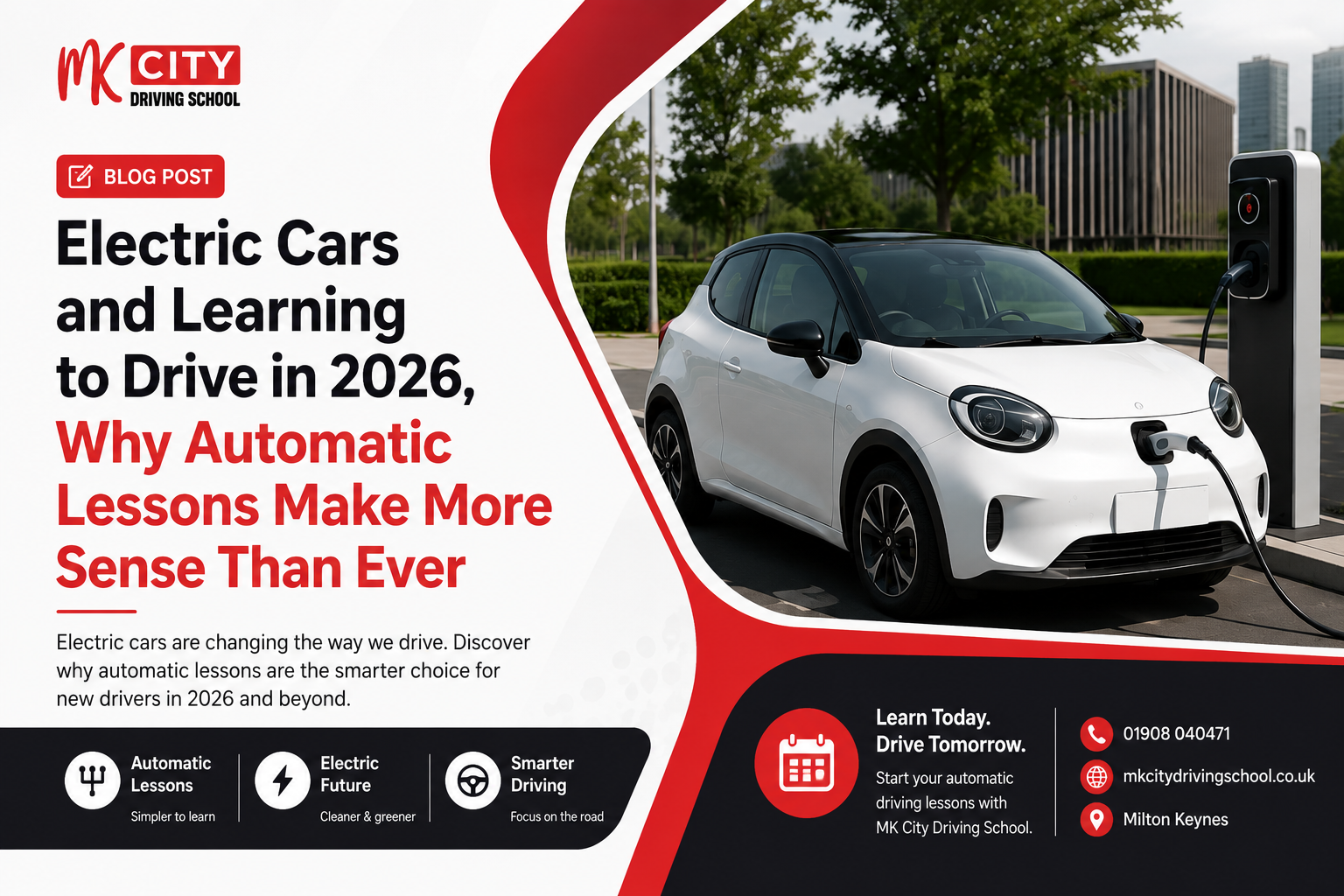
The case for choosing automatic driving lessons over manual has shifted significantly over the past several years, and by 2026 the practical reality of the UK car market means that decision deserves a fresh look. Electric vehicles, which are always automatic, now make up a substantial and growing share of new car registrations in the UK, and the government’s confirmed timeline for ending new petrol and diesel car sales means this trend will only continue.
For learners in Milton Keynes deciding between automatic and manual lessons, this shift changes the calculation in a way that simply was not true a decade ago. This guide explains exactly why automatic lessons make more practical sense for a growing number of learners in 2026, what the genuine trade offs still are, and how to make the right decision for your specific situation.
At MK City Driving School, our driving instructors in Milton Keynes offer both automatic and manual lessons, and this article reflects the honest guidance we give every learner who asks us which to choose.
The Shift Toward Electric and Automatic Vehicles
The UK government confirmed that the sale of new purely petrol and diesel cars will end, with hybrid vehicles given a slightly longer runway before their own sale restriction applies. Every electric vehicle sold in the UK is automatic. There is no such thing as a manual electric car, because the way an electric motor delivers power makes a traditional gearbox unnecessary.
This means that as the UK car market continues its shift toward electric vehicles through the remainder of the decade, the proportion of cars on UK roads that are automatic will continue to rise steadily. For a learner starting their driving journey in 2026, the car they are likely to own and drive for most of their driving life is considerably more likely to be automatic than it would have been for someone learning a decade earlier.
This is the central practical shift that changes the automatic versus manual calculation. The question is no longer simply about preference or coordination. It is increasingly about which licence type aligns with the cars you are actually likely to drive over the coming years.
What the Licence Difference Still Means
This remains the single most important factual point in the automatic versus manual decision and it has not changed with the shift toward electric vehicles. If you pass your driving test in a manual car, your licence covers both manual and automatic vehicles. If you pass in an automatic car, your licence restricts you to automatic vehicles only, and you cannot legally drive a manual car without taking a further test.
For a learner who is confident they will drive electric or other automatic vehicles for the foreseeable future, this restriction carries genuinely less practical weight than it did when manual cars dominated the UK roads. For a learner who anticipates needing to drive a manual vehicle, whether for work, for borrowed or hired cars, or for older vehicles still in family or social use, the manual licence remains the more flexible choice.
The decision in 2026 is less about which is theoretically more flexible in the abstract, and more about a realistic assessment of what you will actually be driving over the coming years.
Why Automatic Lessons Suit More Learners Now Than in the Past
Automatic driving lessons have always offered a faster, less complex route to test standard for many learners, because removing clutch control and gear changes frees attention for road awareness, hazard perception, and the specific demands of busy roads such as those found across Milton Keynes. This benefit has not changed. What has changed is the context around it.
A decade ago, choosing automatic lessons for ease of learning came with a meaningful long term trade off, because most cars on the road were manual and an automatic only licence genuinely limited your options for borrowing, hiring, or eventually buying a car. In 2026, with automatic and electric vehicles forming a steadily growing share of the car market, that long term trade off has narrowed considerably for many learners.
For learners in Milton Keynes who anticipate driving primarily modern, hybrid, or electric vehicles, choosing automatic driving lessons now offers the genuine learning advantages it always has, with a meaningfully smaller long term cost than it carried in the past.
Who Should Still Choose Manual in 2026
Despite the shift toward automatic and electric vehicles, there remain clear and specific reasons to choose manual lessons that have not gone away.
Employment remains the most significant reason. Many driving roles, including delivery work, trades, agricultural work, and certain logistics positions, still rely heavily on manual vehicles, and this is unlikely to change as quickly as the consumer car market. A learner with career plans in any of these areas should weigh this carefully before choosing automatic.
Hire vehicles, particularly outside the UK, remain predominantly manual in much of continental Europe, even as the UK market shifts. A learner who anticipates significant international travel involving hire cars should factor this into their decision.
Family and social driving situations also matter. If the people around you predominantly drive manual cars, and you anticipate ever needing to drive one of their vehicles, an automatic only licence creates a genuine limitation that is worth considering honestly before committing to automatic lessons.
The Learning Experience: What Still Holds True
Regardless of the shift in the wider car market, the core learning advantages of automatic driving lessons in Milton Keynes remain unchanged. Without clutch control and gear management to manage simultaneously, learners can direct their full attention toward the genuinely demanding road network that characterises Milton Keynes, including the grid road system, the dual carriageway speeds on roads such as the H6 Childs Way and V6 Grafton Street, and the high density of multi lane roundabouts including the Grafton Gate interchange.
Stalling, one of the most common sources of early learner anxiety, simply does not happen in an automatic. Many learners who struggle with manual coordination for weeks find their confidence increases noticeably within a small number of automatic lessons once gear management is removed from the equation entirely.
For learners considering an intensive driving course in Milton Keynes, automatic is frequently the faster route to test standard for exactly this reason, allowing the concentrated daily practice of an intensive programme to focus entirely on roundabout reading, speed management, and hazard awareness rather than splitting attention between these skills and gear changes.
Making the Decision in 2026
The most useful framework for this decision in 2026 is to honestly answer two questions. First, what type of vehicle do you realistically expect to drive for most of your driving life over the next five to ten years. Second, are there any specific circumstances in your life, whether career, travel, or family, where you might genuinely need to drive a manual vehicle.
If your honest answer to the first question is modern, hybrid, or electric vehicles, and your answer to the second question is no clear specific need for manual, then automatic lessons represent a genuinely practical choice in 2026 that carries less long term cost than it would have a decade ago.
If your answer to either question points toward a continuing need for manual flexibility, the manual licence remains the more sensible long term investment, even though it typically requires a few additional hours of training to reach test standard.
If you remain genuinely unsure, an assessment lesson with one of our local driving instructors in Milton Keynes is the most useful next step. Your instructor will observe your natural coordination and discuss your specific circumstances honestly, helping you make the decision with real information rather than guesswork.
Frequently Asked Questions
Q: Are electric cars always automatic?
Yes. Every electric vehicle is automatic. The way an electric motor delivers power makes a traditional manual gearbox unnecessary, which is why no manual electric vehicles exist on the market.
Q: Does it make more sense to learn automatic in 2026 than it did before?
For many learners, yes. As electric and other automatic vehicles make up a growing share of the UK car market, the long term limitation of an automatic only licence has narrowed for learners who expect to primarily drive modern, hybrid, or electric vehicles. The decision should still be based on your specific circumstances rather than a general trend.
Q: Can I drive a manual car if I pass my test in an automatic?
No. If you pass your test in an automatic vehicle, your licence restricts you to automatic vehicles only. You would need to pass a further test in a manual vehicle to gain the ability to legally drive manual cars.
Q: Are automatic driving lessons faster than manual lessons in Milton Keynes?
Often, yes. Removing clutch control and gear management from the learning process allows many learners to focus more effectively on the specific demands of Milton Keynes roads, including the grid road network and the high density of roundabouts. Many learners reach test standard in fewer total hours when learning in an automatic.
Q: Should I choose manual if I want to keep my career options open?
If you have any reasonable prospect of needing to drive a manual vehicle for work, including delivery, trades, or logistics roles, a manual licence remains the more flexible long term choice. This consideration has not changed with the shift toward electric vehicles in the wider consumer market.
Q: Can I switch from automatic to manual lessons later if I am not sure?
Yes, although switching partway through training typically means restarting elements such as clutch control and gear management from the beginning. It is more efficient to decide before you start your course. An assessment lesson with MK City Driving School can help you make this decision with an honest recommendation from your instructor before you commit.
Final Thoughts
The shift toward electric and automatic vehicles in the UK car market genuinely changes the practical calculation behind the automatic versus manual decision for learners in 2026. For many learners, particularly those who expect to primarily drive modern, hybrid, or electric vehicles in the years ahead, choosing automatic lessons now carries meaningfully less long term cost than it did a decade ago, while retaining all the learning advantages it has always offered.
At MK City Driving School, our driving instructors in Milton Keynes offer both automatic and manual lessons across the full MK postcode area from MK1 to MK19, and we will give you an honest recommendation based on your specific circumstances rather than a generic answer.
Meet our instructors | View all courses | MK City Driving School home