


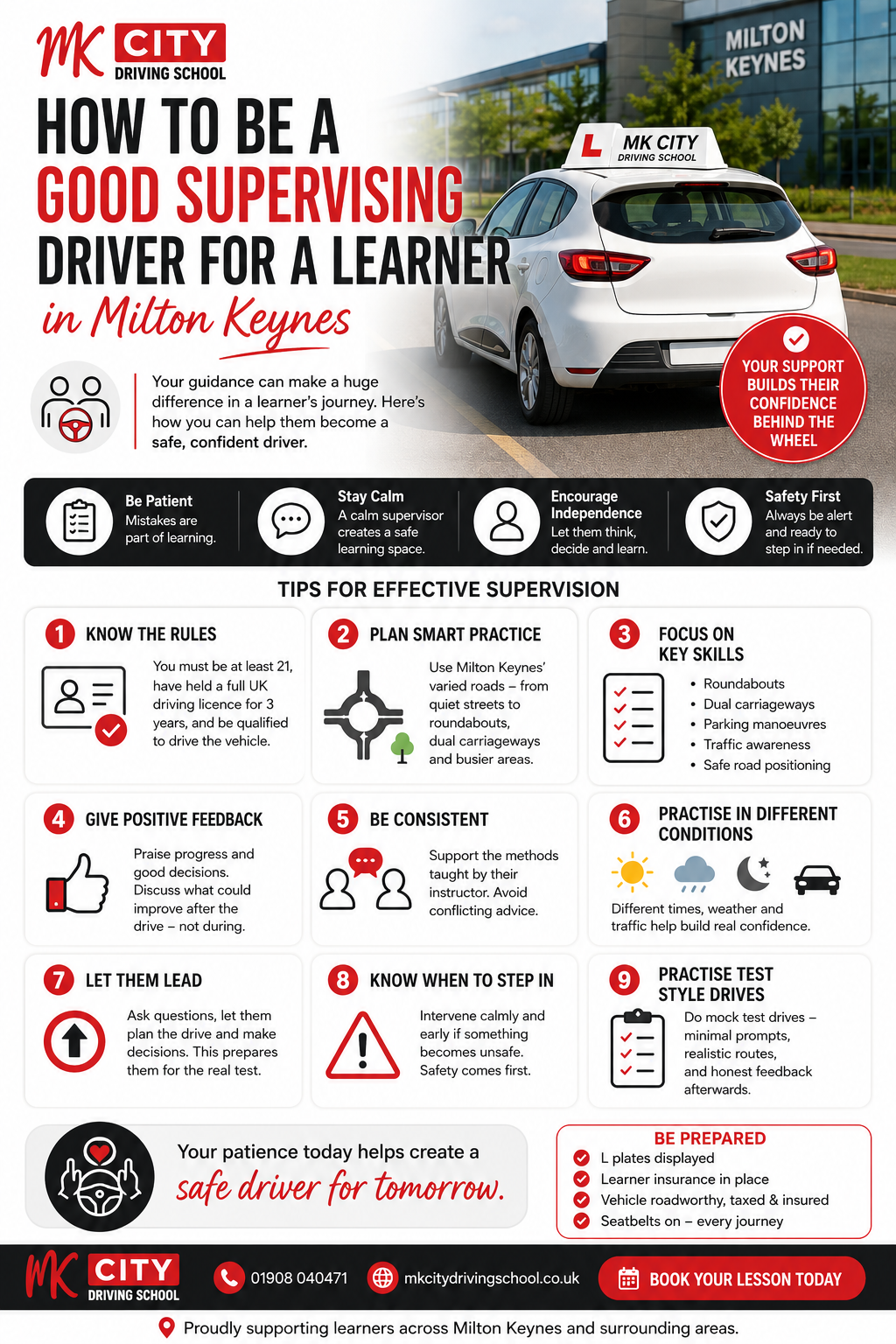
If someone you know is learning to drive in Milton Keynes, you may be thinking about helping them practise between their professional lessons. Supervised private practice is one of the most effective ways to accelerate a learner’s progress and reduce the total number of professional lessons they need. But it requires the right approach, the right legal preparation, and a clear understanding of what your role as a supervising driver actually involves.
At MK City Driving School, our driving instructors in Milton Keynes encourage supervised practice between lessons and regularly advise learners and their families on how to make the most of it. This guide covers everything a supervising driver in Milton Keynes needs to know, from the legal requirements to the practical approach that makes private practice genuinely useful rather than a source of bad habits.
Whether the learner you are supervising is working toward their first test or building confidence after reading our guide on driving test confidence in Milton Keynes, the principles in this article will help you support their progress effectively.
The Legal Requirements for Supervising a Learner Driver
Before any private practice can take place, certain legal requirements must be met. These are not optional guidelines. They are conditions of UK law, and supervising a learner without meeting them exposes both you and the learner to prosecution.
You must be at least 21 years old. There is no exception to this rule. If you are under 21, you cannot legally supervise a learner driver on public roads regardless of your own driving experience.
You must have held a full UK driving licence for at least three years. The three-year period is calculated from the date you passed your full test, not from the date your licence was issued. If you passed your test less than three years ago, you cannot legally supervise a learner, even if you are over 21.
The vehicle must be roadworthy and appropriately insured. Standard car insurance policies frequently exclude learner drivers. You must either confirm that your policy specifically covers a learner driver or arrange separate learner driver insurance for the practice vehicle. This is not an area where assumptions are safe. Check your policy documentation explicitly before any supervised practice takes place.
L-plates must be displayed. Red L-plates must be displayed clearly on the front and rear of any vehicle driven by a learner on public roads. Magnetic L-plates are widely available and can be removed when the learner is not driving. They must be fully visible and not obscured by other items.
Motorways are not permitted. A learner driver may not drive on a motorway unless they are accompanied by an approved driving instructor in a vehicle fitted with dual controls. Supervised private practice must not include motorway driving, even with a supervising driver who has years of motorway experience.
What Your Role as Supervising Driver Actually Involves
Many people who take on the supervising driver role imagine it as sitting quietly while the learner drives. In practice, the most effective supervision is considerably more engaged than that, and understanding your role clearly from the start produces far better outcomes for the learner.
Your primary responsibility as a supervising driver is safety. You are legally responsible for ensuring that the practice session does not create a danger to the learner, to yourself, to other road users, or to pedestrians. This means you need to be paying full attention to the road and traffic conditions throughout the session, not to your phone, not to your own thoughts, and not to the conversation you were having before you got in the car.
Your secondary responsibility is to support the learning process without undermining the professional instruction the learner is receiving. This is where many well-intentioned supervising drivers inadvertently cause problems. If you introduce corrections, habits, or techniques that differ from those being taught by the learner’s driving instructor at MK City, you create confusion that slows progress rather than accelerating it. The most valuable thing you can do as a supervising driver is reinforce what the professional instructor is teaching, not supplement it with your own driving preferences.
Before each practice session, ask the learner what their last professional lesson covered and what their instructor asked them to practise. Then focus the session on exactly that. This approach keeps the private practice aligned with the professional programme and avoids introducing conflicting information.
What to Practise and What to Avoid on Milton Keynes Roads
Milton Keynes has a road network unlike most UK towns, and this creates both opportunities and risks for supervised private practice that are worth understanding specifically.
What to practise in private sessions:
Residential roads in quieter areas of Milton Keynes, such as Stony Stratford, Hanslope, Woburn Sands, and the residential estates around Newport Pagnell, are excellent for early-stage supervised practice. Low speed, limited traffic, and simple junctions allow learners to consolidate the fundamental controls without the additional pressure of the grid road network.
Routes the learner already knows from their professional lessons with MK City Driving School are valuable for building confidence and repetition. Practising the same roads the instructor is using in lessons reinforces the same skills rather than introducing unfamiliar elements.
The approaches to familiar roundabouts, practised repeatedly at low-traffic times such as early Sunday mornings, can help consolidate the lane selection and signalling routines that are central to the Milton Keynes driving test.
What to avoid in private sessions:
The grid roads, including the H6 Childs Way and V6 Grafton Street, should not be part of supervised private practice until the learner’s professional instructor has explicitly confirmed they are ready for them. These roads carry traffic at 40 to 70 miles per hour and require a level of speed and junction management that should be introduced under professional instruction first.
The Grafton Gate interchange and other complex multi-lane roundabouts should similarly be avoided in private practice until the learner’s instructor has specifically introduced and practised them in lessons. Encountering these junctions for the first time in a practice session without professional guidance can install incorrect approaches that then need to be corrected in subsequent lessons.
Night driving is not recommended in supervised private practice until the learner is at a confident intermediate standard and has discussed it with their instructor. Night conditions on MK’s grid roads are specifically addressed in our driving test confidence programme and should be introduced systematically.
Communication During a Practice Session
How you communicate as a supervising driver during the session has a significant impact on the learner’s development. There are specific approaches that help and specific ones that hinder.
Give directions early and clearly. If you are directing the route, tell the learner where you are going well in advance of the junction or turn, not at the moment they need to act. A direction given as the learner is already at the junction is too late to be acted on safely and creates exactly the kind of rushed decision-making that causes errors.
Do not comment on every minor imperfection. Professional driving instructors give structured feedback at appropriate moments. A supervising driver who comments on every small error throughout the session creates anxiety rather than confidence. Reserve feedback for genuinely significant moments and deliver it calmly, after the event rather than during it.
Do not use sudden verbal interventions unless genuinely necessary for safety. A shouted word at a critical moment can cause a learner to freeze or make an instinctive wrong movement. If you need the learner to stop or slow urgently, a calm, clear instruction is more effective than a sharp noise.
After the session, a brief and positive conversation about what went well, with one or two clear points for the learner to focus on next time, is more useful than a detailed critique of everything that was imperfect.
How Supervised Practice Complements Professional Lessons
Professional driving lessons in Milton Keynes with an approved instructor provide structure, expertise, and the correction of errors in real time. Supervised private practice provides volume of repetition, consolidation of recent learning, and confidence building in a lower-pressure environment.
The combination of both produces better outcomes than either alone. Learners who supplement their professional lessons with regular supervised private practice on appropriate roads consistently reach test standard in fewer total professional lesson hours than those who practise only with their instructor. The private practice does not replace professional instruction. It extends the reach of that instruction into a greater volume of real-world driving time.
If you are supervising a learner who is also concerned about managing nerves before their test, our guide on driving test confidence in Milton Keynes covers the specific preparation techniques that make the biggest difference on test day. Sharing that resource with your learner during the supervised practice period is a genuinely useful contribution to their overall preparation.
If the learner you are supervising has experienced a setback such as a failed test and needs to rebuild confidence, our guide on what happens if you fail your driving test in Milton Keynes explains exactly how to approach the next steps constructively.
A Practical Checklist Before Every Supervised Practice Session
Before each session, work through this checklist to make sure the practice is legally sound and as productive as possible.
One: Confirm your driving licence has been valid for at least three years and you are over 21.
Two: Confirm the vehicle insurance specifically covers a learner driver, or that separate learner insurance is in place.
Three: Check L-plates are displayed clearly on the front and rear of the vehicle.
Four: Ask the learner what their last professional lesson with MK City covered and what their instructor asked them to focus on.
Five: Plan a route appropriate to the learner’s current standard, using roads the instructor has already introduced in professional lessons.
Six: Put your own phone somewhere you will not be tempted to check it during the session.
Seven: Confirm you will be giving directions and feedback rather than simply sitting silently, and that you are prepared to be fully attentive throughout.
Frequently Asked Questions
Q: What are the legal requirements to supervise a learner driver in the UK?
You must be at least 21 years old and have held a full UK driving licence for at least three years. The vehicle must be roadworthy, appropriately insured to cover a learner driver, and display L-plates on the front and rear. Learner drivers cannot practise on motorways unless accompanied by a DVSA-approved instructor in a dual-control vehicle.
Q: Can I supervise a learner driver on Milton Keynes grid roads?
Only once the learner’s professional instructor has confirmed they are ready for grid road driving. Roads such as the H6 Childs Way and V6 Grafton Street carry traffic at high speeds and should be introduced under professional instruction with dual controls available before being practised in a supervised private session.
Q: Does supervising private practice actually reduce the number of professional lessons needed?
Yes, when done well. Learners who supplement professional driving lessons in Milton Keynes with appropriate supervised practice consistently reach test standard in fewer professional lesson hours. The key is ensuring private practice reinforces what the instructor is teaching rather than introducing conflicting habits.
Q: What should I do if the learner makes a serious error during a supervised session?
Remain calm, give a clear instruction to stop or slow if necessary, and find a safe place to pause. Address what happened calmly and factually, without anger or excessive alarm, and either continue the session on a simpler road or return home depending on the learner’s composure. Mention the incident to the professional instructor at the next lesson.
Q: How long should a supervised practice session be?
For learners in the early stages of training, thirty to forty-five minutes is typically enough before concentration begins to fade. More experienced learners can comfortably manage sixty to ninety minute sessions. Quality of attention matters more than duration. A thirty-minute session where both the learner and supervisor are fully focused is more valuable than a two-hour session where concentration has drifted.
Q: Can I teach the learner new skills during a supervised session?
No. Your role as a supervising driver is to provide a safe environment for the learner to practise skills already introduced by their MK City instructor, not to introduce new skills or techniques yourself. Introducing your own approaches alongside those of the professional instructor creates confusion that slows progress.
Final Thoughts
A good supervising driver is one of the most valuable resources a learner can have, and doing it well is not complicated. Stay legal, stay focused, reinforce what the professional instructor is teaching, choose appropriate roads for the learner’s current standard, and communicate clearly and calmly. These five principles, applied consistently, make supervised private practice in Milton Keynes a genuine accelerant for any learner’s progress.
At MK City Driving School, our local driving instructors in Milton Keynes are always happy to advise supervising drivers on what to practise, what to avoid, and how to make private sessions as productive as possible. If you or your learner have questions, get in touch.
Meet our instructors | View all courses | MK City Driving School home
MK City Driving School | Milton Keynes, Buckinghamshire | MK1 to MK19 Tel: 07730 038695 | mkcitydrivingschool.co.uk | 7am to 8pm, 7 days a week Serving: Milton Keynes, Bletchley, Newport Pagnell, Woburn Sands, Stony Stratford, Olney, Hanslope and surrounding areas