


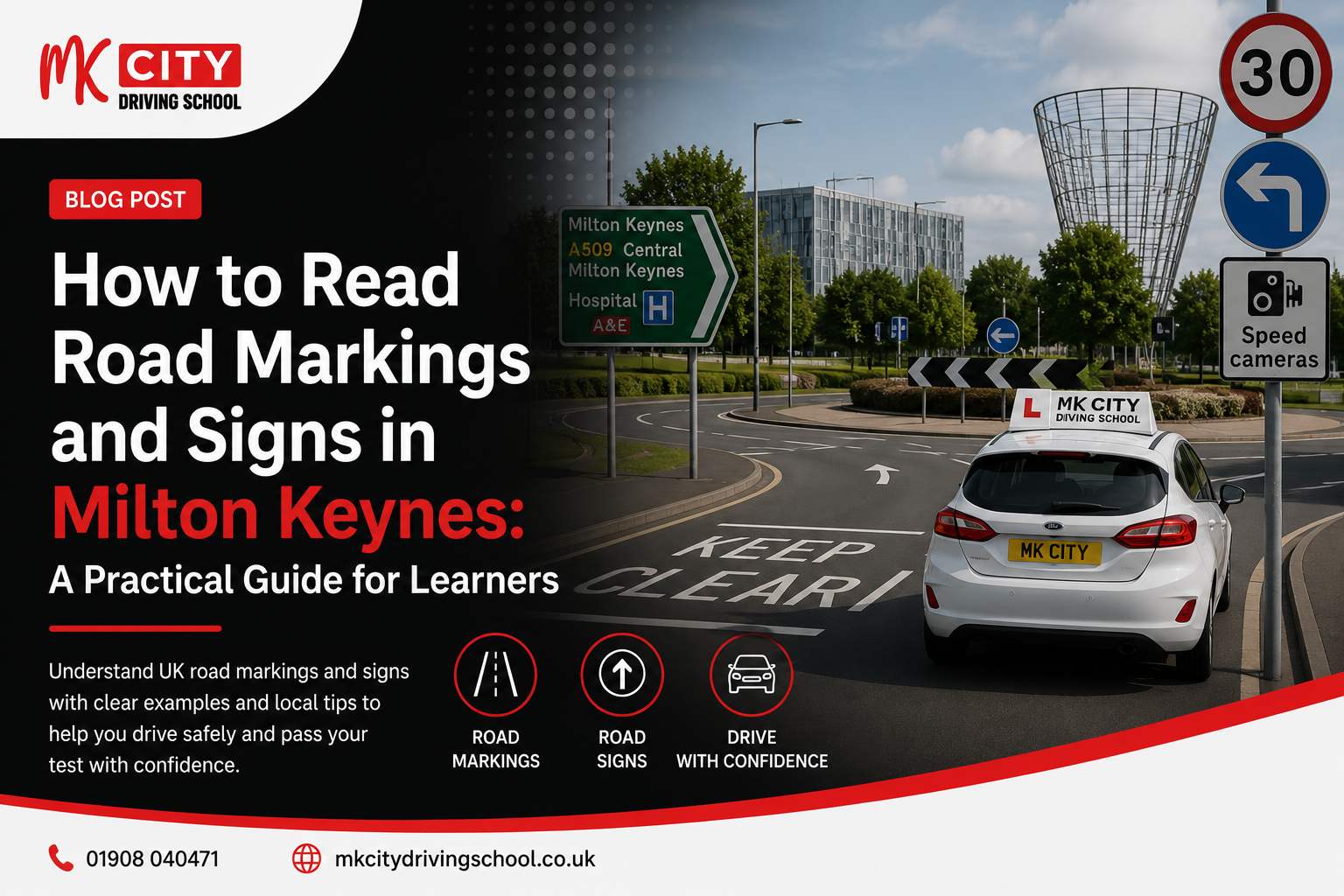
Road markings and signs are the language of the road. Every line painted on a road surface, every sign mounted above or beside it, and every symbol on a junction approach is a piece of structured information designed to tell drivers what the road requires of them at that exact point. Learning to read this language fluently is not a minor aspect of driving competence. It is one of the core skills that separates a confident, safe driver from one who hesitates, guesses, or positions incorrectly because they did not read the road in time.
For learners in Milton Keynes, this fluency is particularly important. The grid road network has its own set of road markings and direction systems that are specific to this town and that learners from other areas, or learners who have not been specifically prepared for them, can find genuinely confusing. The multi-lane roundabouts, the direction arrows embedded in the road surface, and the grid road junction markings all need to be understood clearly before a learner can drive confidently and consistently in MK.
At MK City Driving School, our driving instructors in Milton Keynes teach road markings and signs as an integrated part of practical driving rather than a separate theory topic. This guide explains the key markings and signs learners encounter on Milton Keynes roads and how to respond to each one correctly, with particular focus on the elements specific to the MK road environment.
If you want to understand how road markings affect your confidence on test day, our guide on driving test confidence in Milton Keynes explains the mental side of approaching the Bletchley test centre routes with genuine readiness.
Why Road Markings and Signs Matter More in Milton Keynes
Most UK towns have a road network where the primary information for a driver comes from traditional road signs on posts, traffic lights, and kerb positions. In Milton Keynes, the road surface itself carries a significant amount of additional directional information that is critical for navigating the grid road network, particularly at multi-lane roundabouts and dual carriageway approaches.
Learners who rely primarily on posted signs and instinct for lane selection at roundabouts such as the Grafton Gate interchange consistently make positioning errors that their counterparts who read road surface markings actively and early do not. The direction arrows embedded in the road approach at these junctions are not supplementary information. They are the primary guidance for which lane to be in before you arrive at the roundabout itself, and reading them early enough to act on them is the skill that makes the difference between a confident junction approach and a last-minute, unsafe lane change.
This is one reason why our driving lessons in Milton Keynes specifically address road surface markings at the actual junctions used on the Bletchley test centre routes from mid-course onward, rather than covering markings as a generic theory topic.
White Lines on the Road Surface
White lines are the most common road markings and carry a range of meanings depending on their position, length, and pattern.
Centre lines divide opposite directions of traffic on a single carriageway road. A short broken white line is the standard centre line, indicating that you must stay to the left of it but may cross it to overtake when it is safe and legal to do so. A longer broken line with shorter gaps, known as a hazard warning line, indicates an approaching hazard such as a junction or reduced visibility, and requires extra caution before considering any overtaking manoeuvre. A solid double white line means neither vehicle may cross or straddle the line.
Lane markings on multi-lane roads, including the grid road dual carriageways in Milton Keynes, divide traffic travelling in the same direction into separate lanes. On the H6 Childs Way and V6 Grafton Street, these lane markings are continuous and clearly defined, and positioning within them correctly is a standard expectation on the Bletchley test routes.
Give way lines at junctions consist of a double broken white line across the road at the point where traffic must give way to vehicles on the major road. At roundabouts, the give way line marks the point where you must wait for a gap in circulating traffic before entering. Reading this line in relation to the roundabout flow is fundamental to safe roundabout entry.
Stop lines are a continuous solid white line at the point where traffic must stop at a traffic light or stop sign. A stop line requires you to stop completely at or behind the line, even if the road ahead appears clear, until the signal changes.
Edge lines run parallel to the edge of the road on some roads, particularly dual carriageways including the grid roads in MK. They mark the boundary of the running lane and help drivers maintain road position, which is particularly relevant at night or in poor visibility when the edge of the road is less clearly defined visually.
Direction Arrows on the Road Surface
Direction arrows are one of the most important and MK-specific categories of road marking for learners to understand. These are arrows painted on the road surface in advance of junctions and roundabouts, indicating which lane leads to which direction or destination.
At multi-lane roundabouts in Milton Keynes, direction arrows appear on the approach road, typically 50 to 100 metres before the give way line. They show which exit each lane serves and, critically, which lane a driver intending to take a specific exit must be in before reaching the roundabout. The Grafton Gate interchange is an excellent example: the direction arrows painted in the left-hand approach lane indicate which exits are accessible from that lane, while those in the right-hand lane indicate the exits accessible from there.
The most common roundabout positioning error among learners at complex MK junctions results from reading direction arrows too late. Arriving at the give way line and then attempting to identify which lane to be in is too late. Reading the direction arrows when they first appear, typically 50 to 100 metres before the junction, gives you time to position correctly before the roundabout rather than at it.
At MK City Driving School, we practise this specifically at the actual test-route roundabouts throughout your lesson programme, so that reading and acting on direction arrows becomes habitual rather than something you have to consciously remember under test pressure.
Road Signs: Categories and Their Meanings
The Highway Code divides UK road signs into three primary categories based on their shape, each of which carries a category of meaning that applies across all signs within it.
Circular signs give orders. Red circles prohibit something. A speed limit sign is a circular red-bordered sign telling you the maximum speed you may drive at that point. A no entry sign is a red circle with a white horizontal bar. Blue circles with white symbols give a positive instruction, such as a minimum speed or a mandatory direction.
Triangular signs warn of a hazard ahead. They have a red border and a symbol inside indicating the nature of the hazard. A junction ahead sign, a school crossing sign, or a bend ahead sign are all triangular warning signs. The key behaviour triggered by a triangular warning sign is increased alertness and readiness to reduce speed.
Rectangular signs give information. Blue rectangular signs are used on motorways and dual carriageways. Green rectangular signs are used on primary routes. White rectangular signs appear on local roads. Information signs on the approach to junctions, showing which destination each lane leads to, are rectangular signs and work alongside the direction arrows on the road surface to convey route information.
In Milton Keynes, the approach signs to grid road junctions carry specific grid road information, including the grid road designation such as H6 or V6 and the directional references used within the MK grid naming system. Familiarity with the grid naming system is useful context for understanding these signs, though your MK City instructor will explain them in the context of your specific lesson routes.
Traffic Light Systems and Signals
Traffic lights control vehicle movements at junctions and pedestrian crossings across Milton Keynes. The standard red, amber, green sequence is familiar to most learners from the theory test, but several specific points are worth understanding clearly in a practical driving context.
A red light requires you to stop behind the stop line. You must not proceed until the light shows green, even if the junction appears clear. Creeping forward to the line while the light is red is acceptable provided you stop before crossing it.
The amber light following green indicates that the light is about to turn red. You should stop unless you are so close to the stop line that stopping would be unsafe, in which case you should proceed. Many learner test failures result from either not stopping at amber when there was sufficient distance to do so, or braking too sharply when amber appeared unexpectedly.
At Pelican crossings, the flashing amber signal following red means you may proceed if the pedestrian crossing is completely clear. This is the signal most commonly misunderstood by learners who have not specifically been taught its meaning in a practical context.
A green filter arrow, which appears alongside the main light at some junctions in Milton Keynes, allows vehicles to proceed in the direction indicated by the arrow even when the main light is on red, provided the way is clear.
Road Markings at Pedestrian and Cycling Crossings
Milton Keynes has an extensive redway network for cyclists and pedestrians that intersects with roads at designated crossing points. These crossings are unique to the town and carry specific road markings that learners need to understand.
The road markings at redway crossings in Milton Keynes include give way lines or stop lines depending on the crossing type, alongside the physical crossing surface often marked in a contrasting colour. The expectation at these crossings is the same as at any pedestrian crossing: cyclists and pedestrians using the crossing have right of way when the give way or stop signal applies, and the give way line marks the point at which your vehicle must yield.
Learners who trained elsewhere and are new to MK sometimes treat redway crossings as lower priority than marked pedestrian crossings. They are not. Treat them with the same give way discipline as any marked crossing.
Applying This Knowledge on the Bletchley Test Routes
Understanding road markings and signs as a category of knowledge is useful. Applying them fluently at the specific junctions the examiner will use is what produces a pass.
At MK City Driving School, your practical training from mid-course onward specifically covers the road markings at the junctions used on the Bletchley test centre routes. This means that by your test date, you have read and acted on the direction arrows at Grafton Gate, the give way lines at the roundabout approaches, the stop lines at the traffic lights on the test routes, and the edge lines on the grid road sections, many times over. The markings are familiar. The responses are habitual.
For learners who have experienced a failed test partly due to positioning errors at junctions, our guide on what happens after a failed driving test in Milton Keynes explains how to address specific fault patterns efficiently before your next attempt.
Frequently Asked Questions
Q: What are the most important road markings for learners in Milton Keynes?
Direction arrows on the road surface at multi-lane roundabouts such as the Grafton Gate interchange are the most critical MK-specific markings to understand. Reading these early, at least 50 to 100 metres before the junction, allows correct lane selection before arriving at the give way line rather than at it. Give way lines, stop lines, centre lines, and lane markings on the grid road dual carriageways are the other key categories that all driving lessons in Milton Keynes cover.
Q: What do the three shapes of UK road signs mean?
Circular signs give orders, either prohibitions with red borders or positive instructions with blue backgrounds. Triangular signs warn of hazards ahead. Rectangular signs provide information. This framework applies to every road sign in the UK Highway Code.
Q: Why do direction arrows matter so much on MK roundabouts?
Multi-lane roundabouts in Milton Keynes, such as the Grafton Gate interchange, have multiple approach lanes each serving different exits. The direction arrows on the road surface are the primary guidance for which lane a driver must be in before entering the roundabout for their intended exit. Reading them too late is the most common cause of unsafe last-minute lane changes at these junctions.
Q: Where can I find the full list of UK road signs and their meanings?
The complete and authoritative reference is the Highway Code, published by the DVSA and available at gov.uk/highway-code. Your driving instructor in Milton Keynes will cover the signs most relevant to the MK test routes throughout your practical lessons.
Q: Are the road markings in Milton Keynes different from the rest of the UK?
The standard road markings are the same across the UK. What is specific to Milton Keynes is the volume and complexity of direction arrows at multi-lane roundabouts, the redway crossing markings unique to MK’s network of dedicated cycling and pedestrian paths, and the grid road junction signage that uses the H and V road designation system.
Q: Does MK City Driving School cover road markings as part of every driving lesson programme?
Yes. MK City Driving School covers road markings and signs as an integrated part of practical driving throughout every lesson programme, with specific attention to the markings at the junctions used on Bletchley test centre routes from mid-course onward.
Final Thoughts
Reading road markings and signs fluently is not a theory subject that lives in revision guides and then gets applied on test day. It is a practical skill that should be built progressively through real driving on real roads, so that by the time it matters under examination conditions, it happens automatically rather than consciously.
At MK City Driving School, our local driving instructors in Milton Keynes build this fluency into every lesson programme, covering the specific markings at the specific junctions that matter for the Bletchley test centre routes, across the full MK postcode area from MK1 to MK19.
Meet our instructors | View all courses | MK City Driving School home
MK City Driving School | Milton Keynes, Buckinghamshire | MK1 to MK19 Tel: 07730 038695 | mkcitydrivingschool.co.uk | 7am to 8pm, 7 days a week Serving: Milton Keynes, Bletchley, Newport Pagnell, Woburn Sands, Stony Stratford, Olney, Hanslope and surrounding areas