


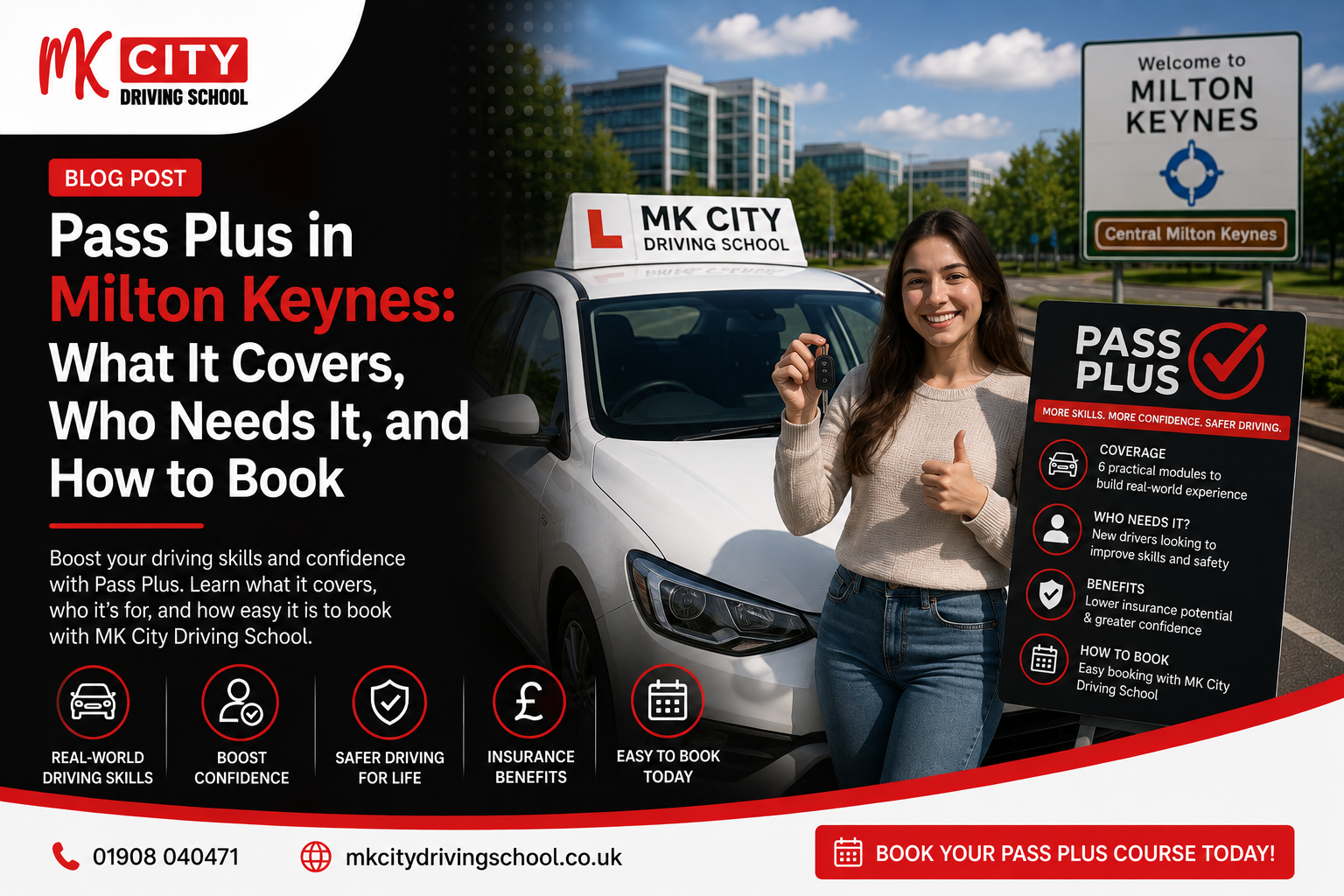
Passing your practical driving test is a significant milestone, but it is also, in a very specific sense, the moment at which your real driving education begins. The standard UK driving test is designed to assess whether a learner meets a minimum competency standard across a defined set of road conditions. What it cannot assess, and does not attempt to, is how a newly qualified driver performs in the full range of real-world conditions they will encounter as an independent driver.
Motorway driving, night driving, all-weather driving, rural road driving, extended dual carriageway driving, and advanced urban driving are all areas that the test either cannot include or does not include in any structured way. Pass Plus is the DVSA-developed post-test programme that addresses exactly this gap.
At MK City Driving School, our driving instructors in Milton Keynes deliver Pass Plus to newly qualified drivers across the full MK postcode area. This guide explains what every module involves, who benefits most from completing it, and why Milton Keynes-based drivers have particular reasons to consider it seriously.
What Is Pass Plus?
Pass Plus is a practical training programme developed by the DVSA for newly qualified UK drivers. It consists of six modules, each covering a category of real-world driving that the standard practical test does not systematically address. The programme is delivered by a registered Pass Plus instructor in a dual-control vehicle and typically takes around six hours to complete, though the exact duration depends on the learner’s starting standard in each module and the conditions available for each session.
Unlike the practical driving test, Pass Plus does not have a pass or fail outcome. The instructor assesses your performance against the required standard in each module and either confirms you have met that standard or gives you additional support until you do. The programme ends when all six modules have been completed to the required standard, at which point your instructor submits your Pass Plus certificate to the DVSA.
The six modules are: town driving, all-weather driving, night driving, rural roads, dual carriageways, and motorway driving. Each builds on the foundation of skills developed during your standard practical training and extends that foundation into conditions that are genuinely new for most newly qualified drivers.
Module 1: Town Driving
Town driving may seem like the most familiar of the six modules, given that most practical tests take place on urban and suburban roads. The Pass Plus town driving module, however, assesses a higher standard of urban driving than the basic test requires.
The focus is on hazard anticipation, traffic management, pedestrian interaction, and the smooth integration of urban driving with junctions, crossings, and the general unpredictability of busy town centre environments. For newly qualified drivers in Milton Keynes, this module specifically addresses the demands of central Milton Keynes driving, including the grid road approaches to the shopping centre area, the pedestrian crossing density in built-up sections, and the management of the grid road network at peak traffic times.
Module 2: All-Weather Driving
The all-weather driving module covers the adjustments that rain, fog, ice, and reduced visibility require. Most newly qualified drivers will have driven in some rain during their lessons, but few will have experienced fog driving, ice, or the specific visibility challenges of heavy sustained rainfall under professional guidance.
The module covers increased stopping distances, the correct use of headlights and fog lights, traction management in wet and icy conditions, aquaplaning and how to respond to it, and the specific behaviours of other road users in adverse conditions. In Milton Keynes, the all-weather module addresses the grid road network in these conditions specifically, including the stopping distances at grid road speeds in rain or ice and the challenges of roundabout approach reading in reduced visibility.
Module 3: Night Driving
The night driving module is one of the most valuable elements of Pass Plus for newly qualified drivers anywhere in the UK, because the practical test is almost always conducted in daylight. Night driving is the experience gap most commonly identified by insurance actuaries as a contributor to newly qualified driver accident risk in the first year.
The module covers headlight management, dipped versus full beam use, managing headlight dazzle from oncoming vehicles, reading road markings in artificial light, stopping distances relative to headlight range, and the different behaviour of other road users after dark. For Milton Keynes-based drivers, the night module specifically addresses the grid road network after dark, including the transition between well-lit central sections and less illuminated rural approaches, and the challenges of roundabout direction arrow reading under artificial light on wet evenings.
Module 4: Rural Roads
Rural road driving presents a specific set of demands that most learners in Milton Keynes will have encountered only rarely during their practical training. The rural roads module covers national speed limit single carriageway roads with limited passing places, blind bends and crests requiring early hazard anticipation, agricultural vehicle encounters, farm access junction hazards, and the management of higher speeds on roads where the visual environment gives fewer cues than urban roads.
For Milton Keynes drivers, rural road competence is directly relevant for journeys to the surrounding Buckinghamshire countryside, North Northamptonshire, and Bedfordshire. The rural roads around Woburn Sands, Hanslope, Olney, and north toward Northamptonshire are all genuinely rural in character and quite different from the managed grid road environment of central MK.
Module 5: Dual Carriageways
The dual carriageway module extends the skills developed on Milton Keynes grid roads to a broader range of dual carriageway environments, including A-road dual carriageways and the approach to motorway conditions. The focus is on lane discipline at sustained speed, safe following distances at 70 miles per hour, overtaking on dual carriageways, and the management of joining and leaving at slip roads and junctions.
For Milton Keynes drivers, the dual carriageway skills developed on the H6 Childs Way and V6 Grafton Street during their practical training provide a solid starting point for this module. The Pass Plus module extends this to dual carriageway environments with different characteristics, including those without the consistent markings and management of the MK grid roads.
Module 6: Motorway Driving
The motorway module is the element of Pass Plus that most newly qualified drivers identify as their primary reason for undertaking the programme. Motorway driving is not part of the standard practical test, and many newly qualified drivers experience the M1 near Milton Keynes for the first time without any prior structured guidance.
The module covers joining a motorway on a slip road, sustained driving at 70 miles per hour, lane discipline and the keep-left rule, safe following distances at motorway speed, smart motorway features including variable speed limits and red X lane closures, and the procedure for breakdowns on both standard and smart motorway sections. For Milton Keynes-based drivers, the motorway module uses the M1 corridor accessible from Junctions 13, 14, and 15, giving preparation directly relevant to the motorway sections they will use for local travel.
Who Benefits Most From Pass Plus?
Pass Plus is relevant for any newly qualified driver, but certain groups benefit more directly than others.
Younger drivers, particularly those in the 17 to 24 age group who are statistically at highest accident risk in their first year, benefit from the structured experience in conditions most associated with first-year incidents. Night driving and motorway driving are the two modules most directly relevant to first-year accident statistics.
Drivers who will use the M1 regularly for work or commuting immediately after passing benefit most from the motorway module, and this describes a significant proportion of Milton Keynes drivers given the town’s direct access to the M1 at multiple junctions.
Drivers who completed their training primarily in fair weather and daylight conditions, which is most learners, benefit from the all-weather and night modules specifically.
Drivers who want to reduce their first-year car insurance premium may benefit financially as well as in terms of safety, since completing Pass Plus can support a reduction in premiums through certain UK insurers.
Frequently Asked Questions
Q: What does Pass Plus cover?
Pass Plus covers six modules: town driving, all-weather driving, night driving, rural roads, dual carriageways, and motorway driving. Each module addresses a category of real-world driving that the standard UK practical test does not systematically assess. The programme is delivered by a registered Pass Plus instructor in a dual-control vehicle.
Q: How long does Pass Plus take?
Pass Plus typically takes around six hours to complete across all six modules, though the exact duration depends on the learner’s starting standard and the conditions available for each session. Sessions are usually arranged across two or three meetings rather than completed in a single day.
Q: Can Pass Plus reduce my car insurance premium?
Yes. Many UK car insurers offer a reduction in first-year premiums for drivers who hold a Pass Plus certificate. The discount varies between insurers. It is worth obtaining quotes specifically as a Pass Plus holder and comparing them with standard first-year quotes to assess the financial benefit.
Q: Is Pass Plus available in automatic and manual formats?
Yes. MK City Driving School delivers Pass Plus in both automatic and manual vehicles. The module content is the same regardless of transmission type.
Q: Does Pass Plus include motorway driving near Milton Keynes?
Yes. The motorway module within Pass Plus delivered by MK City Driving School uses the M1 sections accessible from Milton Keynes, including the approaches at Junctions 13, 14, and 15. This gives preparation directly relevant to the motorway sections MK-based drivers use regularly.
Q: How soon after passing my test should I do Pass Plus?
The most effective time to undertake Pass Plus is within the first few weeks or months of passing your test. This is when your recently developed practical skills are at their freshest and the programme can build most effectively on the foundation of your recent training. That said, Pass Plus is available and beneficial at any point after passing your test.
Final Thoughts
Pass Plus addresses the specific gap between test standard and real independent driving competence in the six areas most commonly associated with first-year newly qualified driver risk. For Milton Keynes drivers, where the M1 is immediately accessible and the grid road network presents specific all-weather and night driving demands, the motorway and night modules are particularly directly relevant.
At MK City Driving School, our local driving instructors in Milton Keynes are registered Pass Plus providers delivering all six modules across the full MK postcode area from MK1 to MK19. If you have recently passed your test and want to build on your standard with structured support, we would be glad to help.
Meet our instructors | View all courses | MK City Driving School home
MK City Driving School | Milton Keynes, Buckinghamshire | MK1 to MK19 Tel: 07730 038695 | mkcitydrivingschool.co.uk | 7am to 8pm, 7 days a week Serving: Milton Keynes, Bletchley, Newport Pagnell, Woburn Sands, Stony Stratford, Olney, Hanslope and surrounding areas