


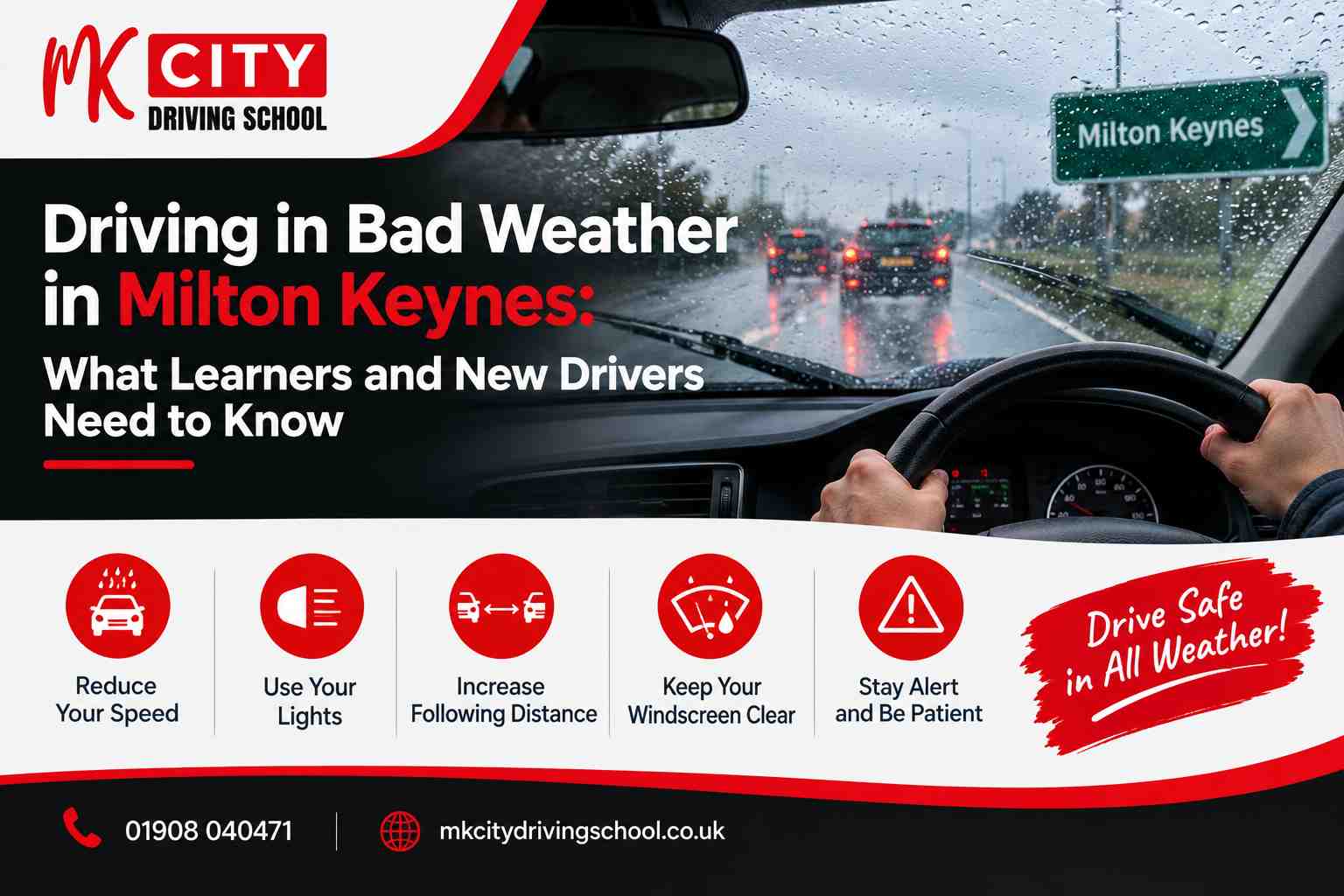
Driving in bad weather is one of the most significant skill gaps between passing a practical test and becoming a genuinely safe independent driver. The standard UK practical test is conducted in daylight and in broadly reasonable conditions. Rain, fog, ice, and strong crosswinds are conditions that most learners encounter during their training only briefly and without structured guidance on how those conditions specifically change what safe driving requires.
For drivers in Milton Keynes, this gap has specific local dimensions. The grid road network, with its long straight sections, higher speed limits, and exposed elevated sections on roads such as the H6 Childs Way and V6 Grafton Street, is more directly affected by bad weather conditions than most UK town road environments. Crosswinds at grid road speeds, surface water on dual carriageway sections, and reduced visibility on the long straight approaches to Grafton Gate and other major roundabouts all create demands that drivers trained primarily in good conditions are encountering for the first time.
At MK City Driving School, our driving instructors in Milton Keynes build weather awareness into every lesson programme across the full MK postcode area from MK1 to MK19. This guide covers every significant bad weather condition and what specifically changes on Milton Keynes roads when each one applies.
Rain: The Most Common and Most Underestimated Condition
Rain is the bad weather condition most learners and new drivers in Milton Keynes underestimate because it is so common that it stops feeling like a special condition. The familiarity of rain on UK roads produces a dangerous complacency in many drivers who treat wet road driving as no different from dry road driving except slightly slower.
The fundamental change rain makes to driving is to stopping distances. The Highway Code states that stopping distances in wet conditions are at least double those in dry conditions. On the H6 Childs Way at 70 miles per hour in dry conditions, the total stopping distance including thinking and braking distance is approximately 96 metres. In wet conditions that figure doubles to at least 192 metres. A driver maintaining the standard two-second following distance gap in dry conditions is maintaining a critically insufficient gap in wet conditions.
The practical implication for Milton Keynes grid road driving is that following distances at grid road speeds in rain need to be significantly larger than what feels natural if your calibration was built in dry conditions. The long straight sections of the H6 Childs Way, V6 Grafton Street, and the approaches to the Grafton Gate interchange give you the space to maintain appropriate following distances in rain. Use it.
Aquaplaning is a specific rain risk on higher-speed sections of the grid road network. Aquaplaning occurs when a layer of water builds between the tyre and the road surface at speed, causing the tyre to lose contact with the road and the vehicle to become temporarily unsteerable. The correct response to aquaplaning is to ease gently off the accelerator without braking or steering until the tyres regain contact with the road surface. Braking or turning during aquaplaning significantly worsens the loss of control. Reducing speed before surface water sections, which appear most commonly at the lower points of the grid road geometry after heavy rain, is the most effective prevention.
Headlights must be used in rain when visibility is reduced. The legal requirement is to use headlights when you cannot see further than 100 metres ahead. In practice, using headlights in any significant rainfall, regardless of whether visibility is technically below 100 metres, makes your vehicle more visible to other drivers and improves your own sightlines on the road surface.
Fog: The Highest-Risk Condition on MK Grid Roads
Fog is the bad weather condition that creates the most acute danger on Milton Keynes grid roads and the one that most learners have the least structured experience of. Standard lesson programmes rarely coincide with genuine fog and the combination of high grid road speeds and significantly reduced visibility creates a risk profile that requires specific technique rather than general caution.
The Highway Code rule on rear fog lights is specific: use rear fog lights when visibility falls below 100 metres. On the H6 Childs Way and V6 Grafton Street in genuine fog, visibility can fall below 100 metres quickly and other drivers approach from behind at grid road speeds. A rear fog light dramatically increases your vehicle’s visibility to following traffic and is not optional in these conditions.
The critical error most drivers make in fog on Milton Keynes grid roads is driving at a speed where they cannot stop within the distance they can see ahead. If your headlights illuminate 50 metres of road ahead in fog and your stopping distance at your current speed is 96 metres, you cannot stop in time for a stationary obstruction that appears at the edge of your visibility. Reducing speed until your stopping distance fits within your visible distance is not overcaution. It is the correct physical response to the conditions.
Do not use full beam headlights in fog. Full beam reflects off the fog and reduces your own forward visibility while doing nothing to improve your visibility to other drivers. Dipped headlights with rear fog lights is the correct combination.
Motorway and dual carriageway sections in fog require particular care because following traffic may be travelling significantly faster than you are. On the approaches to the M1 from Milton Keynes and on the grid road dual carriageway sections, checking your mirrors for approaching traffic at regular intervals while maintaining your own appropriate fog speed is essential.
Ice and Snow: When to Drive and When Not To
Ice and snow on Milton Keynes roads change the driving environment more fundamentally than rain or fog because they affect every aspect of vehicle control simultaneously. Acceleration, braking, steering, and cornering all behave differently on ice and snow, and the changes are non-linear: a road that feels manageable at 20 miles per hour may become genuinely uncontrollable at 30 miles per hour in the same icy conditions.
The Highway Code states that stopping distances in icy conditions can be up to ten times those in dry conditions. On the H6 Childs Way at 40 miles per hour on ice, the theoretical stopping distance becomes approximately 480 metres. No following distance that feels normal in ordinary conditions is remotely adequate in ice.
For learners in Milton Keynes, the most important thing to understand about ice is that the grid roads are gritted before residential roads in severe cold, which means the grid road surface may be safer in icy conditions than the residential roads that connect to them. Your MK City instructor will advise on routing in cold weather conditions during your lessons.
Black ice is the most dangerous form of ice because it is invisible. It forms most commonly on shaded sections of road, on bridges, and in the early morning before air temperatures rise above freezing. The first indication of black ice is often the steering feeling unusually light or the vehicle beginning to slide without any apparent cause. The correct response is to ease off the accelerator very gently, make no sudden steering inputs, and allow the vehicle to slow naturally until traction is regained.
The honest guidance on driving in severe ice and snow is that in conditions where the roads are genuinely iced and gritting has not been completed, not driving is a legitimate and sensible choice. A journey that can wait until conditions improve should wait.
Strong Wind: A Specific Grid Road Risk
Strong crosswind is a weather condition that affects Milton Keynes grid roads more than most UK drivers encounter elsewhere, because the long elevated straight sections of the grid road network are exposed in a way that town centre roads and residential streets are not.
At grid road speeds, a strong lateral gust can cause a vehicle to move significantly out of its lane position without warning. High-sided vehicles such as vans, lorries, and SUVs are affected more than low-slung cars. On the H6 Childs Way and V6 Grafton Street in strong wind, maintaining a slightly wider gap from the vehicle ahead gives you more time and space to correct any wind-induced movement before it becomes dangerous.
Gaps in roadside structures, trees, or buildings along grid road sections create channelling effects where wind speed increases suddenly as a vehicle passes through an open section. Being prepared for this on the approaches to the large roundabout interchanges on the grid road network, where the surrounding landscape opens up, is worth including in your general grid road awareness in high-wind conditions.
Bad Weather and Your Driving Lessons in Milton Keynes
For learners in Milton Keynes, bad weather lessons are among the most valuable sessions in any training programme. Encountering rain, reduced visibility, and cold road conditions for the first time with an instructor alongside you, able to guide your response and correct your approach, is fundamentally safer than encountering these conditions for the first time alone after passing.
At MK City Driving School, lessons in genuine bad weather conditions are treated as teaching opportunities rather than cancellations where possible. The specific demands of the H6 Childs Way and V6 Grafton Street in rain, the Grafton Gate roundabout approach in reduced visibility, and grid road driving in cold conditions are all elements of the Milton Keynes driving environment that our learners benefit from experiencing with professional support before they encounter them independently.
For newly qualified drivers who want structured post-test guidance in adverse weather conditions specifically, our Pass Plus programme includes an all-weather module covering exactly these conditions in a dual-control vehicle with a registered instructor. For everything about preparing yourself mentally as well as practically for challenging driving situations, our driving test confidence guide covers the preparation mindset that applies equally to test conditions and real-world driving demands.
Frequently Asked Questions
Q: Do I have to use headlights in rain in Milton Keynes?
You must use headlights when visibility is reduced to 100 metres or less, which the Highway Code defines as the point at which headlight use is legally required. In practice, using headlights in any significant rainfall regardless of precise visibility distance makes your vehicle more visible to other drivers on the grid road network and is strongly recommended.
Q: What is the stopping distance on ice compared to a dry road?
The Highway Code states that stopping distances in icy conditions can be up to ten times those in dry conditions. On the H6 Childs Way at 40 miles per hour, the dry stopping distance of approximately 36 metres can become up to 360 metres on ice. Following distances and approach speeds need to reflect this change entirely.
Q: When should I use rear fog lights in Milton Keynes?
Use rear fog lights when visibility falls below 100 metres. On the H6 Childs Way and V6 Grafton Street in genuine fog, this threshold is reached quickly. Switch them off when visibility improves. Leaving rear fog lights on when visibility is adequate dazzles following drivers and reduces the effectiveness of your brake lights.
Q: Is it safe to drive on Milton Keynes grid roads in snow?
Grid roads are typically gritted before residential roads in severe cold, which may make them safer than the surrounding residential network in the early stages of a snowfall. However, in genuine ice and snow conditions, stopping distances on any road are dramatically longer than normal and the grid road speeds make this risk more acute. If conditions are severe and the journey is not essential, not driving is a valid and safe choice.
Q: Does MK City Driving School teach in bad weather conditions?
Where conditions are safe to do so, MK City Driving School treats bad weather as a teaching opportunity rather than a cancellation reason. Learners in Milton Keynes benefit significantly from experiencing rain, reduced visibility, and cold conditions on the grid road network with a professional instructor before encountering them independently.
Q: What is aquaplaning and how do I avoid it on MK grid roads?
Aquaplaning occurs when a layer of surface water builds between your tyres and the road at speed, causing the vehicle to lose steering and braking contact with the road surface. It is most likely on the lower-lying sections of the grid road network after heavy rain. Reduce speed before surface water sections, maintain adequate tyre tread depth across all four tyres, and if aquaplaning occurs ease gently off the accelerator without braking or steering until traction is regained.
Final Thoughts
Bad weather driving on Milton Keynes grid roads requires specific awareness that goes beyond general caution. The long straight sections, higher speed limits, and exposed geometry of the H6 Childs Way, V6 Grafton Street, and the approaches to major roundabouts such as Grafton Gate all amplify the effects of rain, fog, ice, and wind in ways that make specific knowledge of each condition and its demands directly useful for every driver in the MK area.
At MK City Driving School, our local driving instructors in Milton Keynes build weather awareness into every lesson programme across MK1 to MK19, treating adverse conditions as part of the complete preparation every learner needs rather than as disruptions to be avoided.
Meet our instructors | View all courses | MK City Driving School home
MK City Driving School | Milton Keynes, Buckinghamshire | MK1 to MK19 Tel: 07730 038695 | mkcitydrivingschool.co.uk | 7am to 8pm, 7 days a week Serving: Milton Keynes, Bletchley, Newport Pagnell, Woburn Sands, Stony Stratford, Olney, Hanslope and surrounding areas